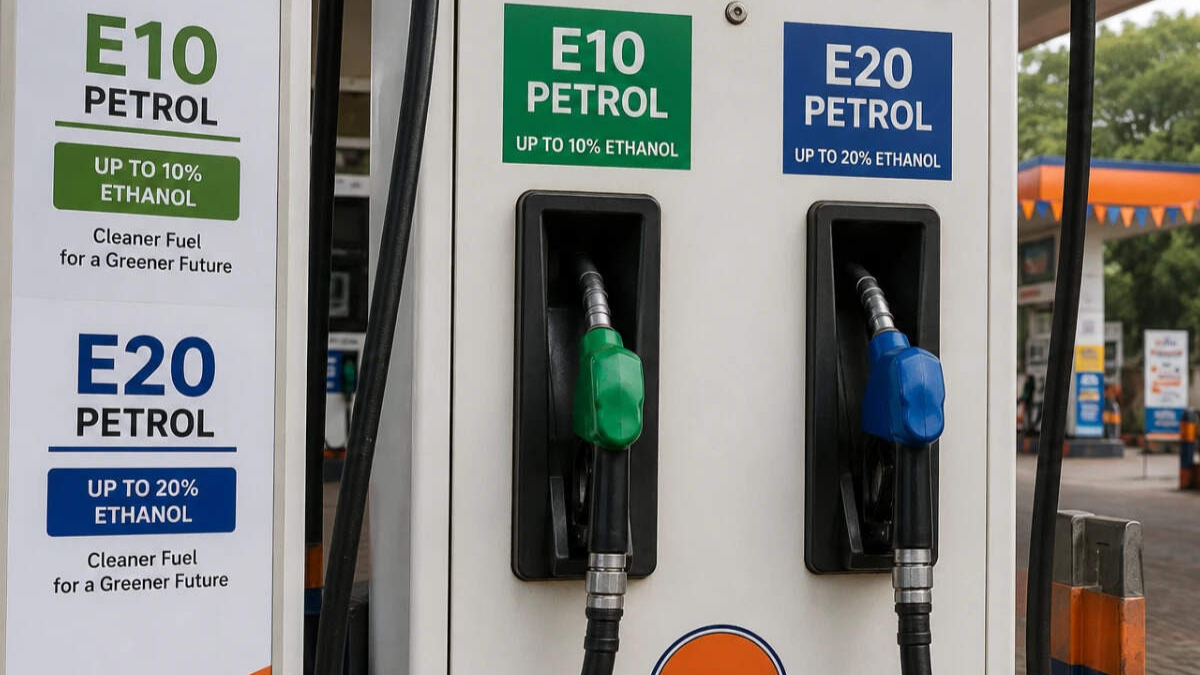
Questions over the absence of fuel options such as pure petrol and lower ethanol blends alongside E20 have drawn a detailed response from the government, which maintains that introducing multiple petrol grades nationwide would be impractical. According to the Centre, supplying pure petrol, E10 and E20 simultaneously would impose significant logistical burdens, increase costs and undermine the efficiency of India's extensive fuel distribution system. It also asserted that although E20 — comprising 80% petrol and 20% ethanol — may reduce fuel economy in certain vehicles by 3-5%, it performs better than pure petrol and lower ethanol blends on several other parameters while being a cleaner fuel.
The government further contended that the country has already made substantial investments to achieve 20% ethanol blending and that rolling back to a lower blend would be an unsound policy decision. India reached the 20% ethanol blending target in petrol last year, after which E20 became the standard petrol available across the country. Its adoption has triggered criticism from sections of the public, with concerns ranging from reduced mileage to wear and tear of engine components in older vehicles that were not originally designed to operate on higher ethanol blends.
In response to those concerns, the government has repeatedly maintained that any reduction in fuel efficiency in older vehicles is marginal and is offset by advantages including a higher octane rating, improved anti-knock properties, quicker combustion, better pickup, smoother acceleration and cleaner engine operation. It has also consistently dismissed allegations that E20 fuel causes damage to engine components. The debate has also led to questions over why motorists in India are not given the option of choosing between pure petrol, E10 and E20, as is done in some other countries.
“…if a cleaner, faster and less-polluting fuel is available, why would we deliberately choose an inferior alternative? The suggestion that every petrol pump should stock pure petrol, E10 and E20 simultaneously also ignores the realities of India’s fuel distribution network. India operates over one lakh retail outlets, supported by an extensive network of refineries, terminals, depots and pipelines. Maintaining multiple grades of base petrol across this vast supply chain would create an enormous logistical challenge, increase handling costs, complicate inventory management and reduce operational efficiency,” the petroleum ministry said Friday in a detailed frequently asked questions (FAQs) note.
The ministry also pointed to the scale of financial commitments already made to support ethanol production.
“Over the past several years, public sector banks have financed nearly Rs 1 lakh crore/yr of investments in ethanol production and associated infrastructure…If, after creating this capacity, we were to arbitrarily revert to E10, what happens to these investments? What happens to the surplus production capacity? What happens to thousands of crores invested by farmers, cooperatives, entrepreneurs, financial institutions and public sector companies in good faith based on a national policy? Public policy must balance consumer interest with energy security, environmental sustainability, farmer welfare and prudent use of national resources,” the ministry said.
Rejecting suggestions that the transition to higher ethanol blending had been rushed, the ministry said E20 was introduced only after consultations with automobile manufacturers and other stakeholders, followed by extensive testing and field validation covering engine durability, fuel systems, material compatibility, corrosion resistance, drivability, emissions and overall performance, rather than being based "on assumptions". Even so, the criticism surrounding E20 has led to indications that the government could postpone the next stage of ethanol blending. On Tuesday, *The Indian Express* reported that the proposed move to E25 fuel is likely to be delayed.
In the FAQs released on Friday, the petroleum ministry reiterated that India's ethanol blending programme began more than two decades ago and noted that “nobody questioned ethanol as a fuel”, particularly because it has long been used in countries such as Brazil and the US. After remaining largely stagnant for nearly a decade, the programme accelerated over the past few years as the present government took steps to ensure adequate ethanol availability.
“When India decided to move towards higher ethanol blends, the automobile industry was involved at every stage. For E10 compatibility, manufacturers were consulted well in advance as early as 2020-21. India achieved its E10 target in June 2022…For E20, an even more rigorous process was followed. Extensive consultations were held with automobile manufacturers, component suppliers, testing agencies and research institutions. The roadmap of the IMC (Inter-Ministerial Committee) had been in the public domain from 2021 and laid out a calibrated path to reaching E20,” the petroleum ministry said.
The ministry said the participation of vehicle manufacturers throughout the process demonstrates their confidence in the fuel's compatibility.
“Had automobile manufacturers not been fully satisfied with the results, they would never have stood behind the product or honoured vehicle warranties. The fact that virtually every manufacturer today is honouring warranty for all vehicles (old or new) is because they have been part of the consultation. Further, Maruti Suzuki serviced 2.84 crore vehicles during FY 2025-26, including 1.5 crore older, non-E20-certified vehicles, and reported no E20-linked corrosion, abnormal wear or component-life damage. Hero MotoCorp has reported similar field experience. This real-world evidence is far more reliable than isolated anecdotes,” it added.
The ministry also argued that if E20 were actually causing damage to rubber parts, fuel lines or engines, the country would have witnessed lakhs of warranty claims, widespread component failures and a flood of consumer complaints, something it said “has simply not happened”.
It further assured consumers that the ethanol supply chain operates under stringent regulatory oversight. According to the ministry, both ethanol and blended petrol comply with Bureau of Indian Standards (BIS) specifications and are subjected to quality checks throughout the supply chain, from the “distillery to the depot to the retail outlet”.