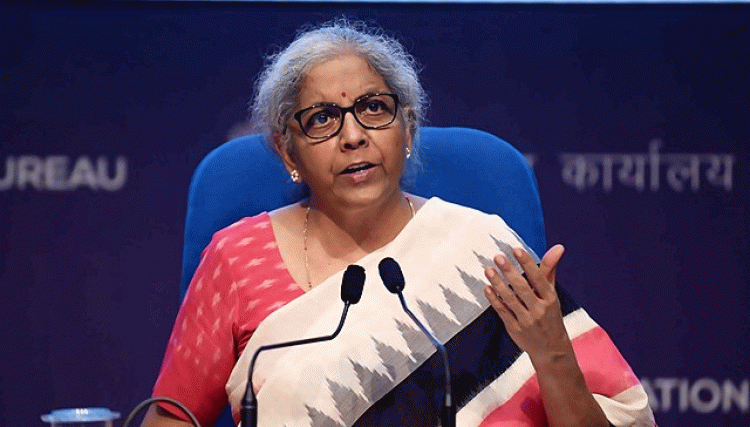


Finance Minister Nirmala Sitharaman on Tuesday presented the Union Budget for the financial year 2022-23. The budget charts out policies and strategies to guide the Indian economy for the next financial year in an era of uncertainty presented by the COVID pandemic. The revenue allocation has been done to achieve the government’s objective of social development among the lowest strata of the society and facilitate job creation to bolster the income of the middle and upper-middle segment of people. Here are the key takeaways from the budget 2022-23:

1. The government will allocate resources to manufacture 400 new generation Vande Bharat trains for the next 3 years.
2. The government of India will allocate ₹19,500 crore for Production-Linked Initiative (PLI) for manufacturing efficient solar modules.
3. Sovereign green bonds will assist the government's borrowing capacity for FY 2022-23.
4. The government will allocate 68% of capital from defence allotment for procuring from the indigenous industry, up from 58 percent last year.
Also read| Nirmala Sitharaman chooses growth with a Budget for India@100
5. The government will allocate 25% of defence allotment for funding indigenous startups, academia and industry to develop local military technology.
6. The government will introduce a provision for voluntary exit of corporates to be cut down from 2 years to 6 months.
7. The government will conduct a 5G spectrum auction in 2022 which will be distributed amongst private companies. The government will also introduce a PLI scheme to provide manufacturing boots to 5G systems.
8. The Government will introduce provisions to provide infrastructure status to energy storage and data centre systems.
9. The government will facilitate the introduction of digital Rupee by the RBI using blockchain technology.
10. All of the 1.5 lakh post offices will be brought on the core-banking bandwagon to promote financial inclusivity in the rural and remote areas of the country. Provisions for net banking, ATMs and mobile banking as well as introduce interoperability between bank accounts and post office accounts for smooth transfer of funds.
Also read| Budget 2022: India to get its own digital currency by RBI next year, says FM
11.World-class university as well as international arbitration centre will be established in GIFT city, free from local regulations.
12. Policies for battery swapping will be introduced to boost EV ecosystem.
13. The Indian government will pay ₹2.37 lakh crore for procuring wheat and paddy under the MSP programme. The government will allocate ₹44,605 crore for the Ken Betwa rivers linking project.
14. The government will extend the policy of redemption of taxes for the startups for another year till FY23.
15. The government will allot ₹48000 crore for PM Awas Yojana. ₹60,000 have been allocated to provide tap-water connections to 3.8 crore houses.
16. The national highway network will be expanded by 25,000 km in FY 2022-23.
17. The Emergency Credit Line Guarantee Scheme (ECLGS) for the MSMEs has been extended till FY 23, cover expanded by ₹50,000 crore to ₹5 lakh crore.
18. The government has proposed to cut Alternate Minimum Tax to 15% on cooperative societies. Surcharge on cooperative societies has been cut to 7% for those having income between INR 1 crore to INR 10 crore.
19. The government has introduced a 30% tax on income on digital assets (cryptocurrencies). Gifts in digital assets will be taxed at the receiving end.
20. The government has capped long-term capital gains tax at 15%.
21. The government has provided a one-time window to rectify omissions in ITRs filed and the updated returns to be filed in next 2 years.
22. Government has proposed a fiscal deficit of 4.5% of the GDP by FY 2025-26. The expected fiscal deficit for FY 2022-23 is .4 percent of the GDP.
23. The government has increased capital expenditure to ₹7.5 lakh crore for FY23, an increase of 35.4%. Effective capital expenditure will be ₹10.7 lakh crore for FY23.
24. No changes in current direct tax slabs for the salaried class.
25. The government expects the IPO of LIC to occur soon. Special Economic Zones Act, 2005 will be replaced with new legislation soon.