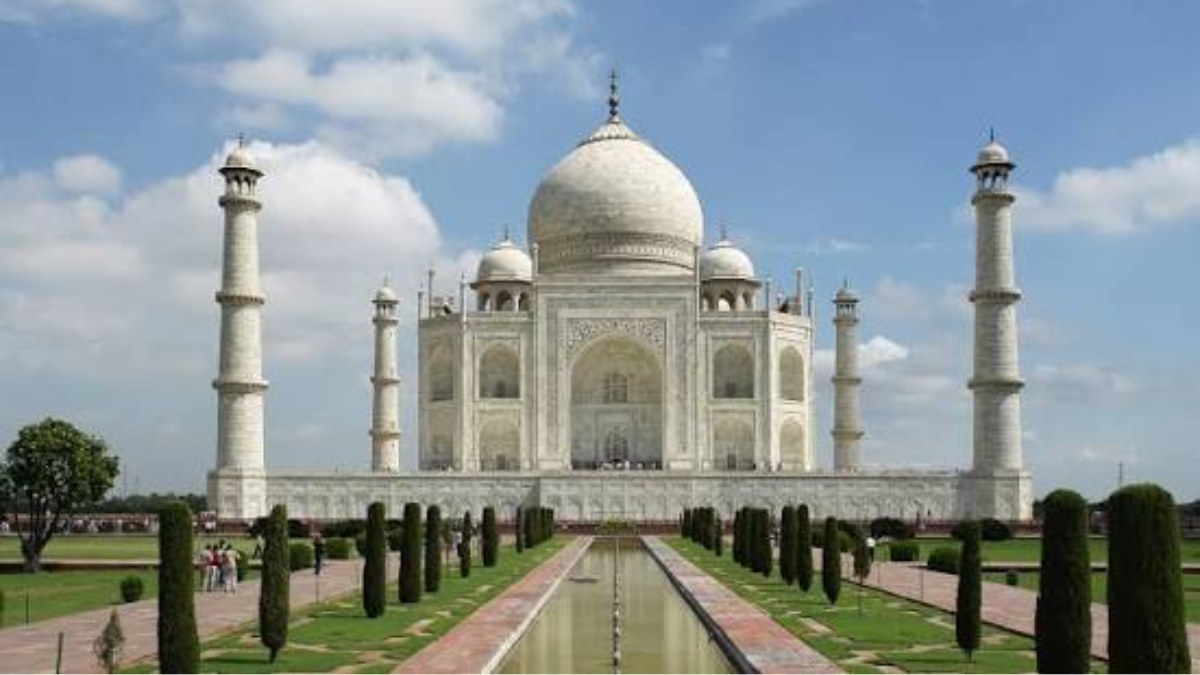


The Allahabad high court on Monday asked the central govt and the Archaeological Survey of India (ASI) to submit their counter-affidavits on a petition challenging an Agra court's refusal to permit a survey of the Taj Mahal.
The case arises from a challenge to orders rejecting a plea for the appointment of an advocate commissioner to carry out an inspection of the monument along with photography and videography.
The petition has been filed on behalf of the deity “Lord Sri Agreshwar Mahadev Nagnatheswar Virajman” through its “next friend”, advocate Hari Shankar Jain, together with several devotees. The petitioners maintain that the Taj Mahal is an ancient Hindu temple known as “Tejo Mahalaya” and dedicated to Lord Shiva.
Justice Rohit Ranjan Agarwal passed the order after hearing submissions from advocate Hari Shankar Jain, who represented the petitioners before the court.
In their plea, the petitioners have sought a declaration that the Taj Mahal is a Hindu temple. They have also requested permission for themselves and other members of the Hindu community to perform darshan and offer prayers within the monument's premises, arguing that Hindus are entitled under Article 25 of the Constitution to perform darshan and puja there.
The dispute traces back to 2019, when the petitioners approached an Agra court seeking the appointment of an advocate commissioner to conduct a survey of the Taj Mahal.
That application was dismissed by the additional civil judge (senior division), who held that the plaintiffs had not produced revenue documents, including khasra or khatauni, to establish the exact gata number. The court also found that the property's boundaries and area, as described by the plaintiffs, were inconsistent with the records relied upon by the defendants.
The petitioners later filed a revision petition before an additional district judge in Agra, but it was dismissed as not maintainable in April this year.
Questioning both decisions, the petitioners moved the high court, repeating the historical and architectural assertions set out in their original suit.
According to the petition, the ancient Tejo Mahalaya Temple, where the deity Agreshwar Mahadev Nagnatheswar Virajman is said to preside, was built by Raja Paramardi Dev in 1155-56 AD. It further states that ownership of the structure later passed to Raja Man Singh and thereafter to Raja Jai Singh of Jaipur.
The petitioners further allege that Mughal emperor Shah Jahan took control of the building from Raja Jai Singh and transformed it into a mausoleum for his wife Mumtaz Mahal by adding Islamic architectural features.
The petition also refers to at least 109 archaeological and historical features which, according to the petitioners, demonstrate that the monument was originally a Hindu temple.
Among the features highlighted is a kalash placed atop the marble dome and adorned with lotus petals, which the petitioners contend is a defining element of Hindu temple architecture.
The plea also points to a structure located at the south-east corner of the complex, claiming it is identified in ASI records as a “gaushala”. According to the petitioners, such a structure is associated with Hindu temples rather than Muslim mausoleums.
In addition, the petition alleges that the ASI has unlawfully allowed Muslims to offer namaz on Fridays while limiting public access to the monument and keeping several of its floors locked.
The petitioners have argued that the Agra court's order suffers from “patent illegality”, “material irregularity” and a failure to exercise jurisdiction.
They have maintained that the request for appointing an advocate commissioner was rejected on considerations unrelated to the purpose of such an exercise, particularly since there is no dispute over the identity of the monument.
The petitioners have further submitted that, because they do not enjoy unrestricted access to the ASI-protected monument, appointing a court commissioner to undertake photography and videography is necessary for the proper adjudication of the suit.
They have accordingly urged the high court to quash the orders passed by the Agra courts and direct the trial court to decide their application for the appointment of an advocate commissioner on its merits.
Separately, the petitioners have filed an interim application seeking directions to the director of the ASI to photograph both the interior and exterior of the monument in their presence and place those photographs before the high court.
Also Read | Cops Say Siya Goyal Studied and Learned From Sonam Raghuvanshi's Mistakes