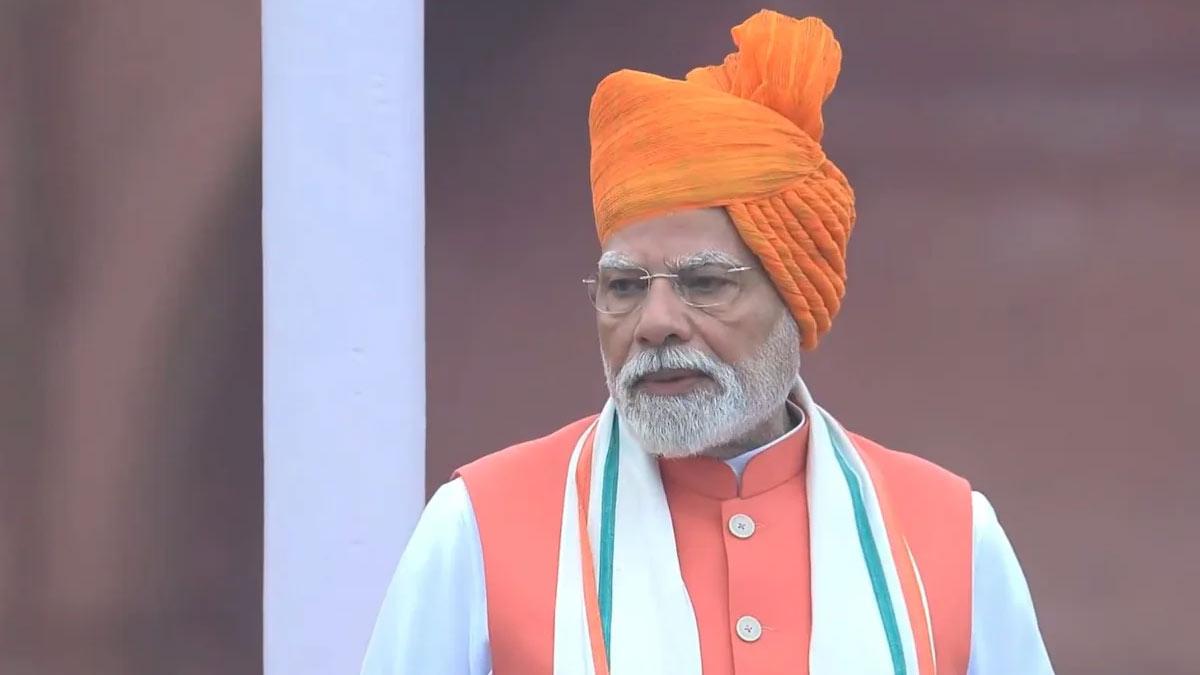


Prime Minister Narendra Modi on Friday emphasized the need for indigenous development of jet engines, pointing towards a large technology gap and asserting self-reliance as the key to India's goal of becoming a developed nation by 2047.
I appeal to India's young scientists, bright youth, engineers, professionals, and all government departments that we should develop our jet engines for our Made-in-India fighter jets," Modi said in his Independence Day speech from the Red Fort. He further stated that indigenously producing jet engines will make future defence technology purely domestic.
The Light Combat Aircraft (LCA Mk-1A) program, crucial for bolstering the Indian Air Force fleet, has been delayed in part by issues in procuring F404-IN20 engines from US firm GE Aerospace. Hindustan Aeronautics Limited is already in talks with GE Aerospace for collaborative production of F414 engines in India for the more advanced LCA Mk-2 program. The $1-billion deal encompasses an 80% transfer of technology.
Modi appealed to the spirit of innovation in India to overcome the challenge. "The same way we developed vaccines during Covid, and UPI for digital payments, we should develop our jet engine also. Our scientists and young people have to take it up as a direct challenge," he declared.
Production of aero engines continues to be a major challenge for India. Defence Minister Rajnath Singh said in April that the nation is talking to international companies like Safran and Rolls-Royce to build indigenous expertise in the vital field.
Modi also hailed Operation Sindoor as an exhibition of India's strategic autonomy and defence self-reliance, pointing to how the military destroyed terror modules in Pakistan with indigenous weapons.
"Indigenous capabilities, such as Made-in-India weapons, allow India to act independently and effectively, proving that national security cannot be based on foreign dependence. They didn't know what was hitting them. If we were not self-reliant…we would have been concerned about who would provide us weapons and systems. But there was no worry or barrier as our armed forces employed indigenous weapons. What we did for self-reliance in defence in the last 10 years bore fruit," Modi said.
Indigenous military equipment employed during Operation Sindoor was Akash surface-to-air missiles, Samar system (surface-to-air missile for assured retaliation), loitering munitions, and several counter-drone weapons.
Emphasizing the dangers of foreign dependence, Modi urged, "Dependence on others makes questions regarding a nation's independence. It is sad when dependence turns into a harmful habit. That's why we have to stay awake and resolute in becoming self-reliant. Self-reliance is not about exports, imports, the rupee, or the dollar…It is about our capabilities, our strength to stand on our own."
Operation Sindoor, initiated in the early morning of May 7 in response to the Pahalgam terror attack that resulted in the loss of 26 lives, targeted terror and military centers in Pakistan and Pakistan-occupied Kashmir (PoK). Indian forces between May 7 and the May 10 ceasefire destroyed nine terror camps, eliminating at least 100 terrorists, while the Indian Air Force attacked 13 Pakistani airbases and military facilities.
Modi added that the reach of such operations was so vast that fresh details about the devastation kept surfacing. India on Thursday celebrated its soldiers who had been central figures in Operation Sindoor, with President Droupadi Murmu giving sanction to several wartime honors. Thirteen of the 15 Vir Chakra recipients attended the Red Fort festivities, two being awarded posthumously.
"India has made up its mind that nuclear blackmail and threats will not be accepted. Even in the future, if the enemy carries on [supporting terror], our armed forces will operate on their terms, choose the time, employ their tactics, and choose the targets," Modi stated.
His words follow increasing rhetoric from Pakistan in the form of threats of nuclear use and threats of war over water disputes after suspension of the Indus Waters Treaty.
Reacting to these challenges, India warned Pakistan of "painful consequences" in case of any misadventure. Modi further said, "India has now made up its mind, blood and water won't run together. The country has understood that the Indus Waters Treaty was unfair. Water from the Indus River system was feeding enemy fields while our farmers went unserved.
Read also| Bombay High Court says Aadhaar, PAN, voter ID don't make one an Indian citizen
Read also| "Better Recalcitrant Than...", says Shashi Tharoor On US Official's India Remark