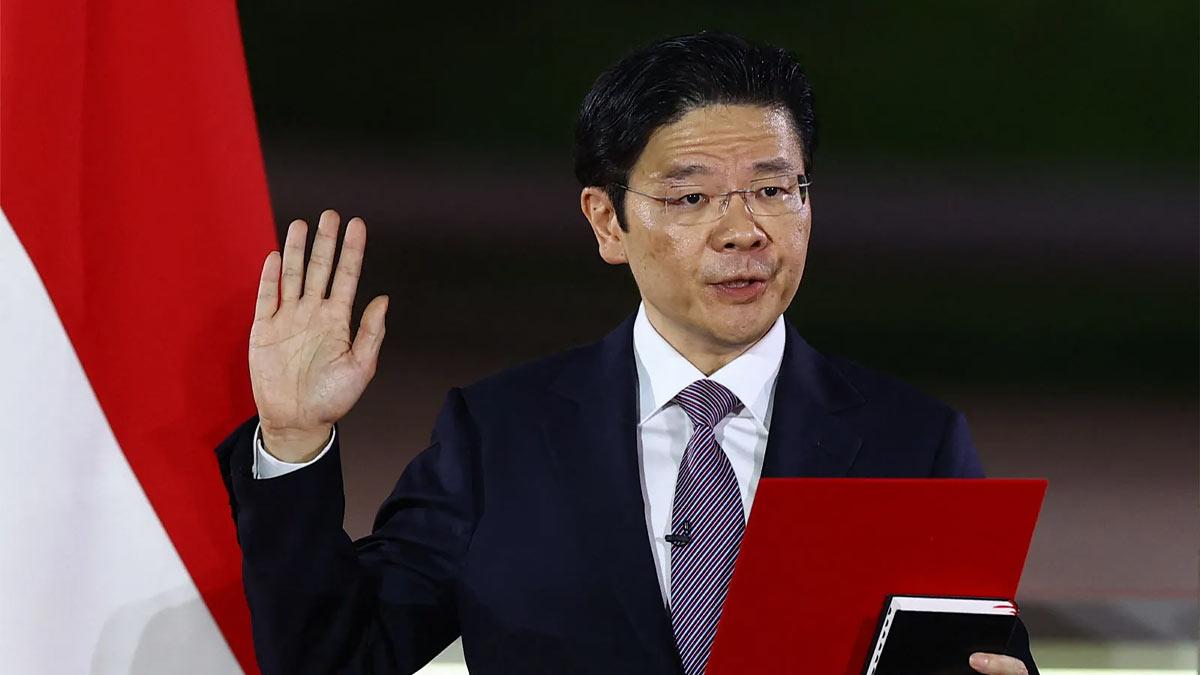


A stable and emerging India is important in ensuring stability and resilience for Asia while presenting new avenues for regional partners, Singapore Prime Minister Lawrence Wong said on Wednesday before meeting Prime Minister Narendra Modi, when both premiers are set to lay out a new roadmap for the bilateral relationship.
Emphasizing Singapore's faith in India's future prospects, Wong also added that the city-state is still India's single largest source of foreign direct investment, with nearly 24% of total FDI inflows coming in. "So we will continue to invest in India, we will continue to have confidence in India’s prospects for the future," he said in a conversation with HT, citing the nation's youth population, growing middle class, dynamic technology industry, and reformist government.
As part of efforts to make India a hub for semiconductors, Singapore is backing a "green lane" for semiconductor products. The agreement is intended to facilitate the supply of raw materials and machinery, enhance collaboration among the two nations' ecosystems, and harmonize industry standards, Wong said.
At the international level, Wong conveyed Singapore's apprehension regarding the current trade tensions between India and the US and US-China differences.
“The one thing we can do proactively is to work with like-minded countries to foster closer links, to operate on the basis of a rules-based trading framework to bring our economies closer together…We believe we can do so with India because we have with India a strategic partnership built on 60 years of friendship and trust,” he said.
You’re in India for your first visit as Prime Minister after the third meeting of the India-Singapore Ministerial Roundtable (ISMR), which oversees economic cooperation. How would you assess this meeting and how has ISMR advanced bilateral cooperation?
ISMR has made a lot of progress. The first ISMR was convened in 2022. At that time, Singapore was undergoing a leadership transition. There was an expectation I would take over as Prime Minister. We were asking ourselves at that time how can we inject new energy into the bilateral relationship, because we already had the Comprehensive Economic Cooperation Agreement (CECA), a breakthrough for India, for Singapore. But years had passed and we wanted to do something more. That’s when the idea of ISMR came about and I decided to lead the first ISMR. I brought a delegation of ministers to New Delhi to meet their counterparts, and that was unique because then we didn’t just discuss cooperation on a ministry-by-ministry basis. We could look at it from a more strategic perspective .
I remember in 2022, we had very good discussions and very good ideas and I had the chance to call on Prime Minister Modi then and he…fully supported the ideas the ISMR put up. Three years have passed, I’ve handed over the leadership of ISMR in Singapore to my deputy prime minister. They met recently, continue to put up very good ideas and advance our cooperation further.
When Prime Minister Modi and I last year announced an upgrade in our bilateral relations to a comprehensive strategic partnership, it’s not just in name, it’s in substance. There’s a lot of substance now in terms of new cooperation that we are pursuing. This year when I’m here in India for my first official visit as Prime Minister, we look forward to taking things forward and institutionalising this bilateral mechanism, ISMR. It’s a unique mechanism.
You are meeting Prime Minister Modi on Thursday and what are going to be some of the major takeaways or key outcomes?
One of the key items that the officials have been planning for is for both of us to announce a roadmap for the comprehensive strategic partnership (CSP). We will have an ambitious roadmap setting up all the different areas of cooperation and how we want to pursue them further, the different pillars. This will give clear direction and vision for the next phase of India-Singapore relations. And there’s a lot to talk about. For example, on economic cooperation, we’re discussing how we can bring it together even closer in areas like semiconductors and industrial parks, which India is pursuing. In skill development, we are supporting India’s National Centre of Excellence for Skills. In connectivity, be it in maritime, air or digital connectivity....
And we are discussing new areas of cooperation. For example, in space, where India has tremendous strengths and we have had Singapore low-orbit satellites being launched right here . So it’s going to be a full agenda . I’m looking forward to having that discussion with Prime Minister Modi to see how we can crystallise [and] take further all of these different areas of cooperation. It’s also quite remarkable [that] the last time Prime Minister Modi and I met, it was soon after he entered his third term. Now, a year later, soon after my election, I am visiting India. Within that short period, a lot of the cooperation has continued to advance . That’s what India-Singapore cooperation is based on. Not just on words and rhetoric, but on concrete action and outcomes. I believe in this very turbulent world that we are in, the bilateral relationship between our countries has become more important than ever.
What has been the progress in Singapore’s efforts to help India create a semiconductor hub and in skilling? Why is it important for Singapore to see India moving up the semiconductor value chain?
We have made good progress in this area . It was something that Prime Minister Modi raised with me when he visited Singapore last year. Since then, we’ve signed an MoU and we’ve made progress across three different areas. One, in having a green lane for semiconductor goods because the semiconductor industry is not just about making the chips. You need raw materials, equipment [and] suppliers. We are trying to bring the two ecosystems closer together through a green lane that will facilitate exchange and align best practices and standards. Second, in skills development because with semiconductors we need skilled technicians and workers. We are supporting India’s development of skills in this area, including discussing the potential of doing a joint skills training centre in Gujarat for semiconductors. Thirdly, in collaboration around research and innovation, where we have some strengths and we think India potentially can do a lot more and we will see how we can work together in these areas too.
Why is Singapore interested in all of this? I offer you three reasons. First, semiconductors are important in today’s economy. You need chips to propel the digital economy forward. Given the strategic importance of semiconductors, we do want, in the world, a more diversified and resilient supply chain. India can contribute to this. Second, we have companies in Singapore interested in the opportunities that India offers. Many semiconductor players in Singapore are leading global companies. They make their own decisions. But we do have Singapore suppliers that are part of that semiconductor ecosystem. They are very keen to see how they can come to India and forge links with Indian players and have opportunities here to grow their business. Thirdly, I would say a strong and rising India contributes to stability, resilience and shared prosperity in Asia. And that opens up new opportunities, not just for India itself but for its partners around the region. That’s why we came to see how we in Singapore can play a part in supporting India’s development in this industry.
In the changed geopolitical circumstances, is India still a safe bet for Singaporean investors because you are the largest investor in India ?
With investments, they are never a safe bet. If you want a safe bet, then you don’t make any money. You must take risks. There will always be short-term volatility with investments but we try to take a long-term perspective. From that point of view, we are optimistic about India’s growth prospects because of your youth, population, rising middle class, dynamic tech sector, and importantly, a government that’s committed to reforms. Our confidence in India is not new. It’s longstanding and it’s backed by a proven track record and actions. We had a CECA agreement 20 years ago and since then our trade has grown by two-and-a-half times. Singapore is the largest investor in India for seven consecutive years now. So we will continue to invest in India, we will continue to have confidence in India’s prospects for the future. As to what industries and what areas, we have to leave it to the private sector. The government itself is not investing, but we set the conditions, we set the framework. From what we understand when we engage businesses and investors in Singapore, there’s a lot of interest in areas like hospitality, advanced manufacturing, sustainability, logistics. So these are all areas potentially where we can see more investment flows coming into India from Singapore.
How are you looking to India to help Singapore with green energy and is there interest in working with India for food security?
We have an interest in both. For green energy, we are doing our plan to accelerate Singapore’s decarbonisation journey. It’s more difficult for Singapore, compared to many other countries because of our constraints. We are a city-state, we don’t have a lot of land, we don’t have access to renewable energy at scale. The decarbonisation journey for Singapore will inevitably consist of a portfolio of solutions, including importing green energy from around us, from our neighbours, which we are working on in ASEAN, but possibly low carbon hydrogen. It could include carbon capture or carbon credits. We are also exploring the possibility of other options, including civilian nuclear power.
Small modular reactors, maybe?
Possibly. We are trying to build capabilities to understand the technology better because we do see new technologies, be it SMR or even further out into the future, nuclear fusion, which are safer and could potentially be deployed even in a small city-state like Singapore. We are just at the stage of building up capabilities to understand these possibilities. We are working on all of these options. Again, it’s an area where we would very much be interested in working closely with India to strengthen our links and collaboration across the range of different options on energy security.
For food security and food trade, we already have very close links. Where food is concerned, we are trying to do some domestic production but it will be very limited. The reality is we will always be importing most of what we eat in Singapore. Our food security strategy is one of diversification. There again we see India as a potential source. We already import a lot of rice [and] a lot of spices come from India, and our agencies are continuing to engage one another. The ministers discussed this at ISMR, how we can facilitate more trade, have more exchanges amongst the agencies where food safety and regulatory standards are concerned. We will continue to welcome more food imports from India as a way to diversify our food sources and enhance our food security.
One of India’s first successes in a tie-up for digital payments was with Singapore. Where do you see the digitalisation journey going?
This is one area where we believe there is potential to do more. We started with the UPI-PayNow linkage and it’s expanded to more financial institutions and banks. I think it’s been very effective for both sides. We can see how we can be more interoperable with this payments linkage. We have done digital linkage in other areas like digital documentation for shipping and trade. That helps with a more seamless business process. Our central banks are talking about digital assets and how we can collaborate more.
But more fundamentally, I would say there is scope for us to think about having a more seamless cross-border data exchange between our two countries. Because data is what underpins a lot of activities for finance and the digital economy. You need that ability to exchange data more seamlessly. We are exploring the possibility of a pilot cross-border data corridor between India, in Gift City (Gujarat), and Singapore. If we can get that going, I think that will potentially allow us to, from the pilot, understand what are the parameters, the concerns that both sides may have.
This is the digital sandbox that people have been talking of?
That’s right. We are thinking of it through a regulatory sandbox, which we can start exploring. We are hopeful we can advance this particular pilot and the regulatory sandbox idea. Beyond the data itself, you can start talking about how we can collaborate in other areas, including in capital markets, for example. The nexus between data and fintech is very close.
Another related area in the digital space is artificial intelligence, where again, it’s underpinned by data, but…you have a lot of new applications and new technologies. We hope to see closer collaboration.
Possibly on AI hubs?
Possibly, a whole range of possibilities, because with AI, you need the data infrastructure, then the data link becomes important. On top of that, you have your models, you have your applications. You have industry specific models too and applications. And trust, you’ve got to think about safety, responsible use of AI. You’ve got to think about research and new frontiers for AI. All of these are potential for us to collaborate on.
What are Singapore’s views on India pressing for a review of the Asean-India Trade in Goods Agreement (AITIGA)? What can be done to drive trade between India and Asean?
We believe the Asean-India relationship is a very important and critical one. These are long-standing, civilisational ties, grounded on trade and cultural exchanges over a long period of time. Within that context, the Asean-India Trade in Goods Agreement is an important part of this overall relationship. The review is ongoing. We understand India’s concerns. We hope there will be flexibility on the part of the officials that are in the midst of discussions so that they can reach a mutually acceptable outcome for all parties. Because we want that trade to continue flowing, we want to have closer ties between Asean and India. Besides just trading goods, we can forge closer ties in other areas too – connectivity, services, digital connectivity. Asean is trying to integrate our economies with a digital economy agreement. If we can do that together with India, I think that will potentially yield a lot of new opportunities. Asean is trying to connect ourselves with an Asean power grid and to link ourselves up more in terms of sustainability and green energy. Again, there’s potential for us to do more with India. At the strategic level, the Asean-India ties are of critical importance because the center of gravity of the global economy will over time shift toward Asia.
Within Asia, we already have China as one growth engine. India will be the second growth engine, there’s no doubt. We think that Asean can be the third. Combined, these growth engines will contribute to the stability, resilience and continued prosperity of Asia. So it’s within that context that there is a strategic imperative for closer Asean-India ties. We want to encourage India to continue with its Act East policy. Singapore will do our part to facilitate these closer links between India and Asean.
You are here at a time when India and China are rebuilding their relations, and we have the trade tensions between India and the US and the US and China. How do you look at these pulls and pressures and how can India and Singapore work together to address the uncertainty we are seeing?
The world is indeed going through profound changes. The two largest superpowers, America and China, have a critical relationship…that will be the most consequential relationship in the world. The two economies are deeply intertwined. Any attempts at a full decoupling between the two will be highly damaging and destabilising. It’s not going to be cost-free at all. Even a trade war between the two will damage the two economies and send shockwaves across the global economy. While the America-China relationship is no longer the same as before, it will be characterised by tense competition and rivalry. There is still a need for dialogue and engagement and I’m glad both sides are talking and I hope they will find ways to put guardrails around the relationship and find ways to manage their differences and eventually land on a good outcome.
Likewise, we hope America and India will be able to continue their engagement and dialogue and find ways to address some of the issues that have emerged more recently.
Singapore watches all these with great concern. I mean, there’s not much we can do when it comes to the US, China [and] India. But we watch with great concern because we are a small and open economy, very reliant on external demand. All of these global uncertainties, the additional barriers to global trade, impact on external demand and it will have an impact on our small economy. We are concerned about the developments. We will try to do our part to facilitate discussions and engagement and dialogue where possible. But the one thing we can do proactively is to work with like-minded countries to foster closer links, to operate on the basis of a rules-based trading framework to bring our economies closer together and to find win-win outcomes. We believe we can do so with India because we have with India a strategic partnership built on 60 years of friendship and trust. In this very uncertain world, there is all the more reason for us to double down on this very critical India-Singapore relationship. And I certainly look forward to doing so with Prime Minister Modi.
Read also| Trump’s Tariffs on India ‘Backfiring’: US Media