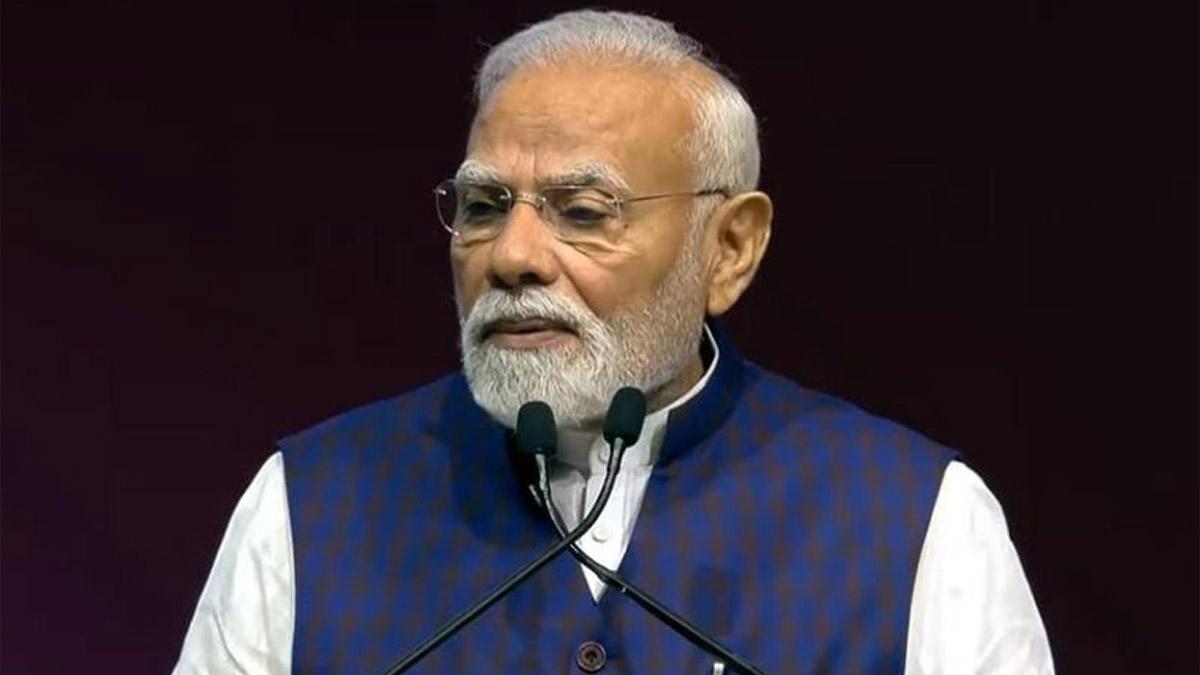


Prime Minister Narendra Modi on Thursday referred to GST 2.0 as a "double dose of support and growth" to the country, adding that his government's agenda of next-generation reforms to create an Atmanirbhar Bharat will go on unabated.
Addressing the winners of the National Teachers' Awards, Modi reminded them of his Independence Day address in which he had committed to a "double dhamaka" of reforms during Diwali and Chhath. Making the announcement, he said that the new, simpler GST regime would be implemented on September 22, marking the first day of Navratri.
Whereas Diwali and Navratri are holidays enjoyed across the country, Chhath is peculiarly significant in Bihar, an election-going state later this year.
"Without timely changes, we cannot give our country its rightful place in today's global context. I had said from the Red Fort on 15 August this time that it is crucial to undertake next-generation reforms to make India self-reliant. I had also promised the countrymen that there would be a double blast of happiness before this Diwali and Chhath Puja," he added.
The Prime Minister's remark came after the GST Council's path-breaking move to reform the current Goods and Services Tax structure and replace it with a simplified two-slab system of 5 and 18 per cent.
Targeting earlier Congress governments, Modi ridiculed their taxation policies. He said that goods of necessity for families, farmers, and even medicines were brought under high taxation by the earlier regimes. "If that regime had continued, you would have been paying 20-25 rupees tax on every transaction worth Rs 100. But the intention of our government is that maximum savings must be made in the life of common people, and people's life is improved," he stated.
The Prime Minister likened the GST reformation system to a 'Panch Ratna'—five gems—that would add value to the economy. They are: a more streamlined tax system, better quality of life, increased consumption and economic growth, greater investment and employment generation through ease of doing business, and more robust cooperative federalism to propel India's growth.
"Gaming is not bad, but gambling is and the future of our youth must be safeguarded," he said, adding that India can dominate the global online gaming market, if it is done in the right manner. "Today, the nation has a government that has political will and that cares for the bright future of the youth. We have enacted the law related to online gaming without heeding to any pressure," the prime minister said.
Inviting youth to bring forward ideas that meet the country's needs, Modi also spoke of the government's new legislation governing online gaming. "Gaming is not wrong, but gambling is and the future of our youth has to be protected," he added, stating that India can lead the world in the online gaming industry if done responsibly. The country has a government that has political will and also cares for the shining future of the youngsters today. We have passed the online gaming law in without listening to any pressure," he stated.
The Prime Minister also asked teachers and students to own the "vocal for local" campaign and encourage the use of local products.
According to the revised structure of the GST Council, common items like roti, paratha, hair oil, ice cream, and televisions will now cost less. The GST incidence on health and life insurance policies has been cut to zero. Premiums for family and individual floater insurance, which previously attracted a tax of 18 per cent, will now be exempt.
Major consumer durable goods such as washing machines and air conditioners will also experience substantial tax cuts. It is the government's expectation that these actions will spur local consumption and serve to cushion the economy from the effects of US tariffs.
Read also| GST Windfall Triggers Market Rally; Sensex Soars by Nearly 900 Points