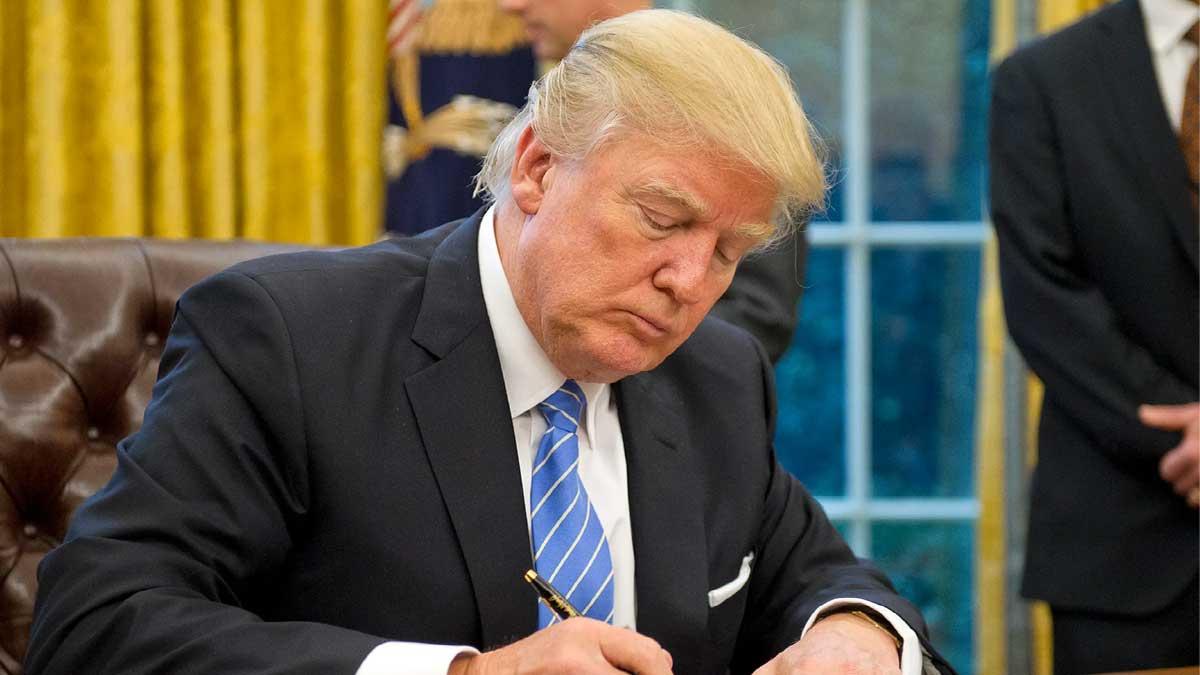


US President Donald Trump on Thursday announced that from October 1, 2025, branded and patented drug imports will be hit with tariffs of as much as 100 per cent. This could make a huge dent in India's pharma industry, one of the local sectors most dependent upon exports to the United States.
"Starting October 1st, 2025, we will be imposing a 100 per cent Tariff on any branded or patented Pharmaceutical Product, unless a Company IS BUILDING their Pharmaceutical Manufacturing Plant in America," the Republican leader said on Truth Social.
Trump's statement shows that his dedication to tariffs does not end with the trade agreements and import levies launched in August, an indication of his conviction that tariffs can help lower the budget deficit of the government while increasing domestic production.
""IS BUILDING" will be defined as, "breaking ground" and/or "under construction." There will, therefore, be no Tariff on these Pharmaceutical Products if construction has started. Thank you for your attention to this matter," he added.
Besides medicines, Trump's new tariffs are a 50 per cent duty on bathroom vanities and kitchen cabinets, 30 per cent on upholstered furniture, and 25 per cent on heavy trucks.
Although he did not give a legal basis for the tariffs, Trump indicated that the levies are required "for National Security and other reasons," which pushes the usual limits of his presidential authority.
The US is India's biggest market for pharma exports. India exported $27.9 billion worth of pharmaceutical goods during FY 24, of which 31 per cent—$8.7 billion (Rs 77,138 crore)—were to the US, as per the Pharmaceuticals Export Promotion Council of India. Exported to the US alone in the first half of 2025 was another $3.7 billion (Rs 32,505 crore).
It has been reported that India provides more than 45 per cent of generic and 15 per cent of biosimilar drugs consumed in the US. Dr Reddy's, Aurobindo Pharma, Zydus Lifesciences, Sun Pharma, and Gland Pharma reportedly get 30-50 per cent of their revenues from the US market.
While the tariffs seem to only affect branded and patented medicines, dominated by multinationals, it remains unclear if India's complex generics and specialty drugs might be impacted as well. Multinational players already have large manufacturing plants in the US.
US consumers largely depend on low-cost generics made in India. If tariffs are levied, it may result in increased drug costs, inflation, and shortages. Indian firms, which have thin margins in the US generic market, might find it difficult to pay for the extra cost, possibly passing it to US consumers or insurers. Trump also had earlier slapped 50 per cent tariffs on Indian imports, including a 25 per cent "penalty" on ongoing Russian oil purchases.
Read also| HSBC Raises India to ‘Overweight’, Predicts Sensex Could Climb to 94,000
Read also| RBI Could Step In to Curb Rupee Volatility: Report