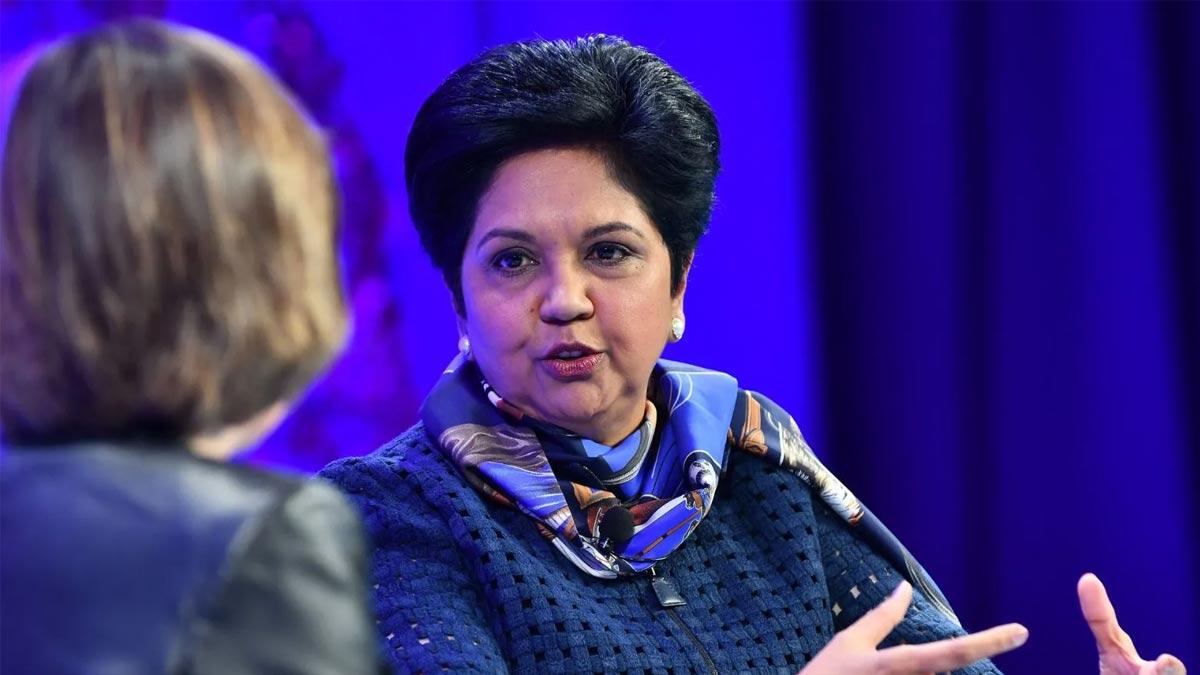


Former PepsiCo Chairperson and CEO Indra Nooyi has sparked a wide-ranging debate on governance, democracy and meritocracy after reflecting on the differences between India, China and the United States during a conversation with former US Secretary of State Condoleezza Rice.
Drawing on her journey from Chennai to the helm of one of America's largest corporations, Nooyi spoke about the opportunities she found in the United States, India's distinctive democratic character and China's emergence as a global power.
Comparing India and China, Nooyi said the two nations offer vastly different experiences. According to her, China is relatively easier for visitors because of its homogeneity and orderly environment, whereas India is defined by its complexity and unpredictability.
“India is a chaotic country. The beauty of India lies in its chaos. Absolute chaos,” Nooyi said.
She said the very disorder that defines India becomes appealing to those who are familiar with the country.
“If you are familiar with India, and you’ve travelled in India before, and you like that chaos all around you, you go back. It’s like a drug. You get addicted to it.”
At the same time, she acknowledged that such an environment is not suited to everyone.
“India is going to be impossible if you like clean, orderly living.”
Nooyi attributed much of India's visible disorder to its democratic system, saying the country's governance model inevitably slows decision-making.
“When everybody has a vote and everybody has a say, progress is slow. But I’m glad it is that way,” she said.
Contrasting India's democracy with China's governance structure, Nooyi said the latter's centralised system played a decisive role in transforming the country into a global power.
“I respect the Chinese system for pulling China out of the dark ages. It became a world power because they did it centrally. India is still struggling to be a world power because democracy rules and progress is slow. But I am glad it is a democracy.”
She also pointed to differences in their legal systems, noting that almost every reasonably sized town in India has a courthouse where citizens can seek justice. In contrast, she said, “The government is your rule maker and your decider.”
Another part of the discussion that drew widespread attention was Nooyi's praise for the United States and what she described as its merit-based system. She said she regularly reminds her daughters of the opportunities available to them by virtue of being born in America.
“I say this to my daughters all the time. I say to them, ‘You have no idea how lucky you are to be born in the greatest country in the world,’ and they look at me and say, ‘Tell us how it’s the greatest.'”
Nooyi argued that although technological breakthroughs may originate in different parts of the world, it is the United States that excels at turning those innovations into successful businesses.
“Technology developed doesn’t make any difference. It’s when you commercialise it and make a difference in the world is where the rubber hits the road.”
Reflecting on her own professional journey, Nooyi said the United States provided opportunities she believes would not have existed elsewhere.
“This is where an immigrant could come in with nothing in her pocket and become the CEO of an iconic American red, white, and blue company. It can’t happen in any other country in the world.”
“I would never have been CEO in any other country in the world, including in India.”
She credited the American system with rewarding ability rather than identity.
“It’s because the system is meritocratic. Mentors don’t care whether you’re male, female, ethnicity, gender, they don’t care, they just want the best brains to rise to the top.”
Nooyi added that preserving this culture of opportunity is essential for future generations.
Her remarks quickly gained traction online, prompting sharply divided reactions across social media platforms.
Some users agreed with her assessment of India, arguing that constructive criticism should be welcomed.
“Very first thing we Indians should start doing is taking constructive criticism. What she said is all true,” one user wrote.
Another user argued that the United States continues to attract exceptional talent because it rewards innovation and hard work.
“If you have a hardcore work ethic, and you build something useful, you have a good shot of winning the long game.”
Others questioned aspects of Nooyi's assessment. One user asked how the United States could be considered more progressive for women when it has never elected a female president.
Another commented, “As somebody who loves the chaos and diversity of India, I refuse to believe that is what makes it unlivable. It is the pollution, cruelty on the streets and trash everywhere that makes it difficult.”
Some users also argued that India's diversity makes direct comparisons with China inappropriate.
“Homogeneous, that’s the keyword. We cannot be homogeneous. Despite all that, we have managed to work together beautifully,” one comment read.
Born and raised in Chennai, Indra Nooyi moved to the United States to pursue higher education at the Yale School of Management. She served as PepsiCo's chief executive officer for 12 years before stepping down in 2018.
Nooyi currently serves on the board of Amazon and remains one of the world's most prominent business leaders, frequently speaking on leadership, governance and economic development.
Also Read | Nestle CEO Fired Over "Romantic Relationship" With Staff Member