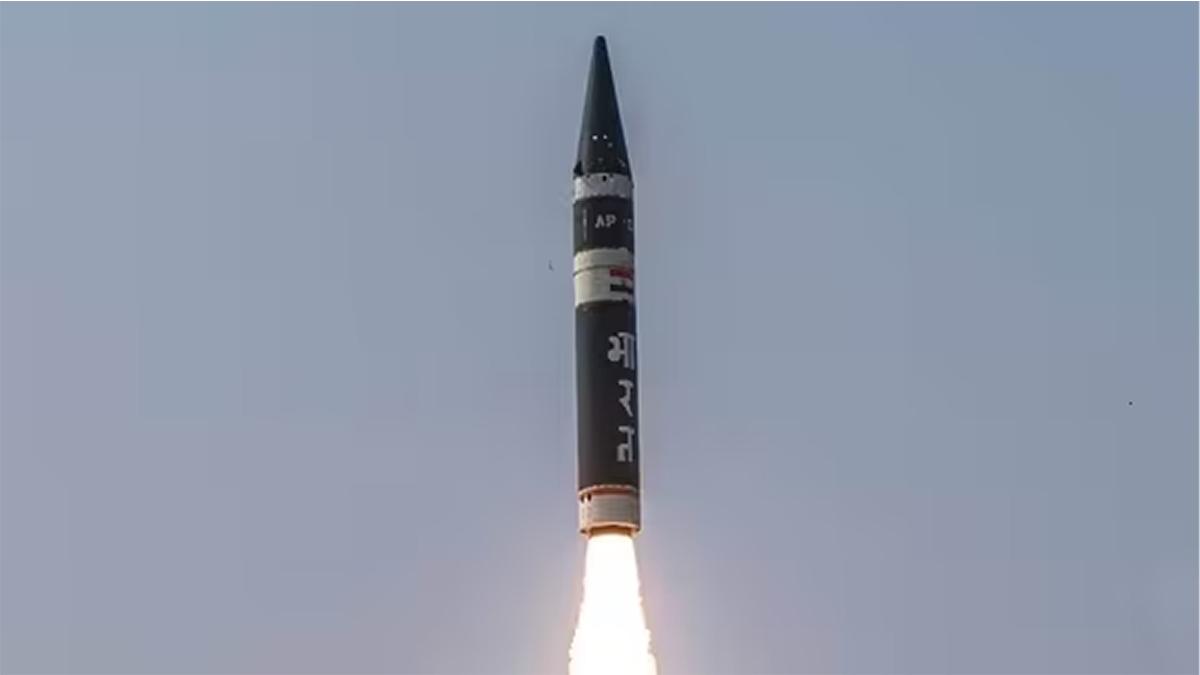


India successfully tested the first-ever rail launch of its Agni-Prime nuclear-capable missile, making the nation part of an exclusive club of countries possessing this sophisticated capability, the defence ministry said on Thursday. The next-generation missile has advanced technology and has the capability to target targets up to 2,000 km away.
“The Defence Research and Development Organisation (DRDO), in collaboration with the Strategic Forces Command (SFC), has carried out the successful launch of intermediate range Agni-Prime missile from a rail-based mobile launcher system, under a full operational scenario on 24th Sep 2025,” the defence ministry said in a statement.
Defence Minister Rajnath Singh observed that the successful test places India in the elite group of nations, along with the US, Russia, and China, which possess a canisterised missile launch system that can be deployed through rail networks.The road-mobile variant of Agni-Prime has already been commissioned into the armed forces, and this rail-based trial will clear the way for induction of advanced rail-mobile systems. The launch was performed with a specially developed rail-based mobile launcher that could operate on the rail system without conditions.
It offers cross-country mobility and is capable of launching within a short reaction time with minimal visibility. It is autonomous and is outfitted with all independent launch capability features such as the latest communication systems and protection mechanisms," the ministry stated.
The flight path of the missile was tracked through several ground stations.
Other members of the Agni missile family produced by DRDO are Agni-I (700 km, Pakistan-targeted), Agni-II (2,000 km), Agni-III (3,000 km), Agni-IV (4,000 km), and Agni-V (5,000 km).
This achievement follows closely on the heels of a successful test by India of an integrated air defence system that could engage targets at different altitudes and ranges. The first trial of Integrated Air Defence Weapon System (IADWS) that is a part of the broader national defence program Mission Sudarshan Chakra consisted of a mix of rapid reaction surface-to-air missiles (QRSAM), very short range air defence systems (VSHORADS), and a laser-based directed energy weapon.
India previously demonstrated a locally built laser system to disable drones in April. The 30-kilowatt directed energy weapon (DEW) test came after the nation conducted its first land test of a scramjet engine, an air-breathing engine that maintains combustion at supersonic velocities, a significant milestone towards developing hypersonic missiles at over Mach 5 speeds.
Few countries in the world—such as the US, Russia, China, the UK, Germany, and Israel—have developed laser-based systems to destroy missiles, drones, and other projectiles globally. Only the US, Russia, and China also have technologies for hypersonic missiles that can make sharp turns at low altitudes and are virtually impossible to intercept.
India's recent achievments of note also involve last year's successful test of the 3,500-km range K-4 nuclear-capable missile from a submarine and the creation of the Agni-5 missile with multiple independently targetable reentry vehicle (MIRV) technology.
Read also| Karnataka HC Dismisses Musk-led X Corp's Plea, Affirms Need for Social Media Regulation
Read also| Centre Extends CDS Gen Anil Chauhan’s Term Until May 2026