

c
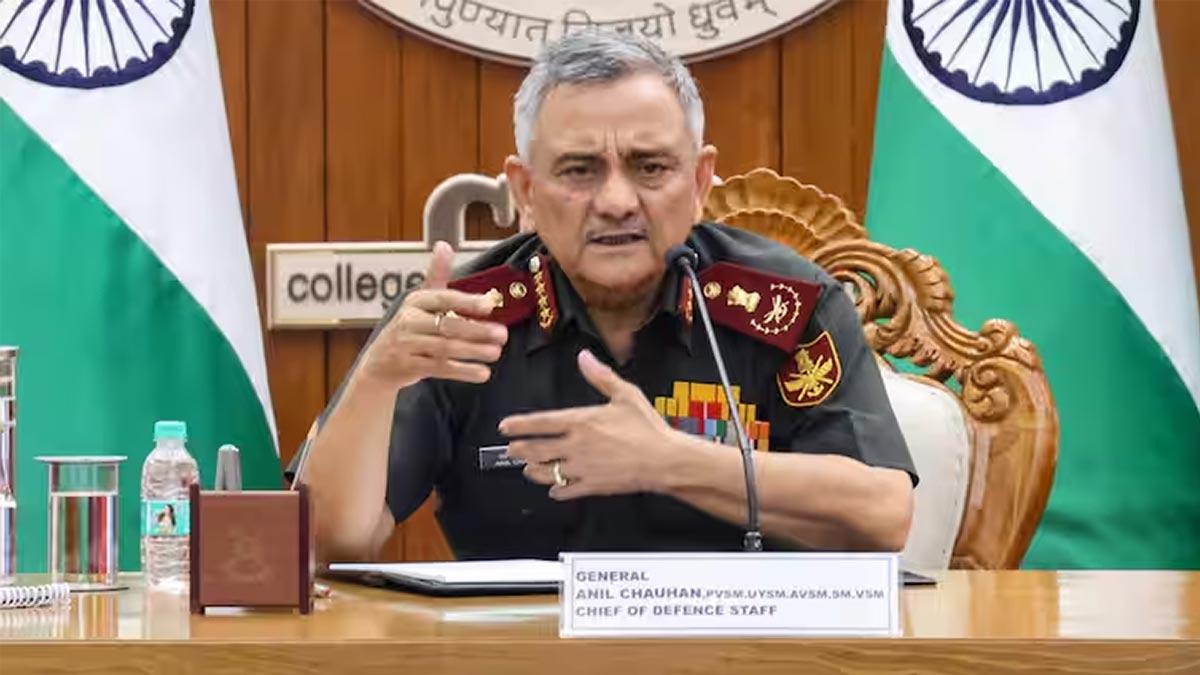
General Chauhan pointed out that contemporary battlefield situations are more and more characterized not only by the power of traditional forces, but by where and how technology and data are used. "We are on the verge of the third revolution which is data-centric warfare with the developments in AI, ML, data analytics and all," he stated.
He drew a distinction between evolutionary and revolutionary changes in the military—arguing that while incremental advancement of weapons is a form of evolution, revolutionary shifts redefine the very nature of war, necessitating that military doctrines, organizational formats, and strategies be revamped. "Revolutionary change occurs like the Ice Age—humans must evolve. If humans are not accustomed to evolutionary change, they become extinct," he cautioned, calling on armed forces to become more innovative and flexible.
Pointing to the advancement of drone technology, Chauhan added what was once a civilian innovation is now a revolutionary capability in military strategy. "Drones allow militaries to complement manned systems and operate simultaneously across multiple domains with minimal resources and less risk to human life," he said.
The deployment of drones, he further noted, has become a key element to battlefield agility and minimizing exposure of people to close combat, hence a key element of future-proof armed forces.
General Chauhan stressed the point that the advent of drones and high-speed missiles has changed the conventional notions of control of airspace. "We used to think air superiority was with manned aircraft flying from the ground up to 60,000 feet. With the introduction of ballistic and hypersonic missiles, including cruise and guided missiles, near-space has now joined the battlespace," he noted.
He explained that airspace at or below 15,000 feet is becoming more congested because of the explosion of UAVs. "This space is different and deserves special treatment and understanding, as it is where most combat is happening today. We must develop UAV systems to capture this space, and counter-UAS systems to take it away from our enemies," he added.
He also urged new paradigms in counter-UAS operations, rules of engagement, and thinking concepts to address the emerging threats from unmanned aerial technology like swarming strategies and autonomous operations.
Reminding everyone of Operation Sindoor, General Chauhan highlighted how India successfully countered threats from drones and, in some cases, even retrieved multiple UAVs in pristine condition. He emphasized that incidents like these are excellent learning points for making Indian defenses stronger against air breaches.
General Chauhan also mentioned the capability of low-earth orbit (LEO) satellites in greatly enhancing the abilities of UAVs by augmenting their navigation and communication capabilities.
Appeal for integrated military innovation
In his valedictory address, General Chauhan emphasized the imperative to re-imagine the planning and conduct of operations in the context of technology advancements. He advocated developing robust unmanned systems, enhancing counter-drone capabilities, and fusing data analytics and AI into core military operations.
"Third revolution is upon us," he emphasized, noting that today's forces have to be prepared for tomorrow's battlespace.
Read also| Indian Army Set to Bolster Firepower with Induction of US Apache Helicopters Next Week
Read also| India Acquires GE-404 Engine from US for HAL’s LCA Mark 1A Fighter Jet Program