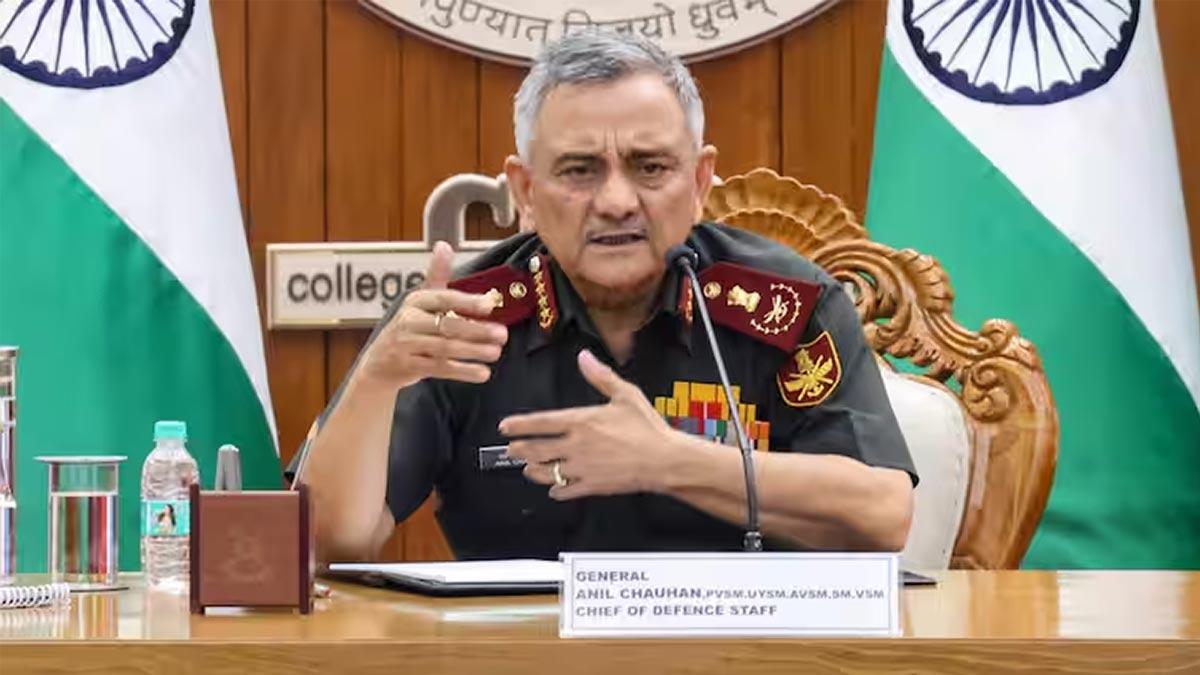


Chief of Defence Staff General Anil Chauhan on Wednesday unveiled fresh information regarding Operation Sindoor, shedding light on how Indian military forces successfully repelled a Pakistani drone attack without suffering any damage.
Addressing a defence-themed workshop organized in New Delhi, General Chauhan elaborated, "On 10th May, Pakistan employed unarmed drones and loitering munitions during Operation Sindoor. None of them caused any damage to the Indian military or civilian infrastructure.
Most of them were neutralized with both kinetic and non-kinetic efforts, and some were even picked up in nearly intact condition."
Operation Sindoor was India's counterattack after the terror attack in Pahalgam. The operation involved precision bombing on terrorist establishments in Pakistan and Pakistan-occupied Jammu and Kashmir (PoJK), together with defensive operations that drove subsequent hostile actions back with success. Indian forces also conducted targeted attacks on Pakistani air bases during the campaign.
General Chauhan took the opportunity to address the growing prominence of Unmanned Aerial Vehicles (UAVs) in contemporary combat operations and emphasized the need for India to develop its own counter-drone capabilities.
"Whenever we discuss the issue of drones, what do you believe these are — are they introducing an evolutionary or a revolutionary shift in warfare?" he asked. "I believe their creation is evolutionary and their utilisation has been fairly revolutionary in warfare. With the realisation of their deployment and extent growing, the Army began utilising drones in a revolutionary way — you have witnessed this in many wars that we have been fighting."
The CDS stood resolute in his position on India's own technological self-reliance in this regard. "Can't count on imported niche tech essential for our missions; reliance on foreign tech dilutes readiness," Chauhan remarked.
He was speaking to the gathering at the Workshop and Exhibition on Indigenisation of Critical Components Currently Imported from Foreign OEMs in the Fields of UAV & C-UAS, which was jointly hosted by the Headquarters Integrated Defence Staff and the Centre for Joint Warfare Studies.
General Chauhan also referred to the overall transformation that military technology has undergone over the years, commenting on the way in which technology has transformed combat weapons to make them more dynamic and effective.
"Evolutionary processes have reduced weapons and war fighting gear to smaller size, lighter weight, increased speed, higher efficiency, lower cost… We once used big, heavy rifles; now they are shorter, lighter, and with longer ranges. The same goes for tanks and aircraft — they are lighter, faster, and provide better protection than before," he noted.
As per a statement from the Ministry of Defence, the workshop was in line with the Aatmanirbhar Bharat mission of the government and seeks to develop a policy framework to reduce foreign dependence within the UAV and counter-UAV ecosystem.
"Identifying the need to cut dependency on OEMs (original equipment manufacturers) for key UAV and C-UAS components, the forthcoming workshop-cum-exhibition seeks to get all the concerned stakeholders on board, including defence specialists, policymakers, military commanders, scientists, and private sector representatives, to frame a strategic roadmap for indigenisation," the ministry added.
Read also| Indian Army Set to Bolster Firepower with Induction of US Apache Helicopters Next Week
Read also| India Acquires GE-404 Engine from US for HAL’s LCA Mark 1A Fighter Jet Program