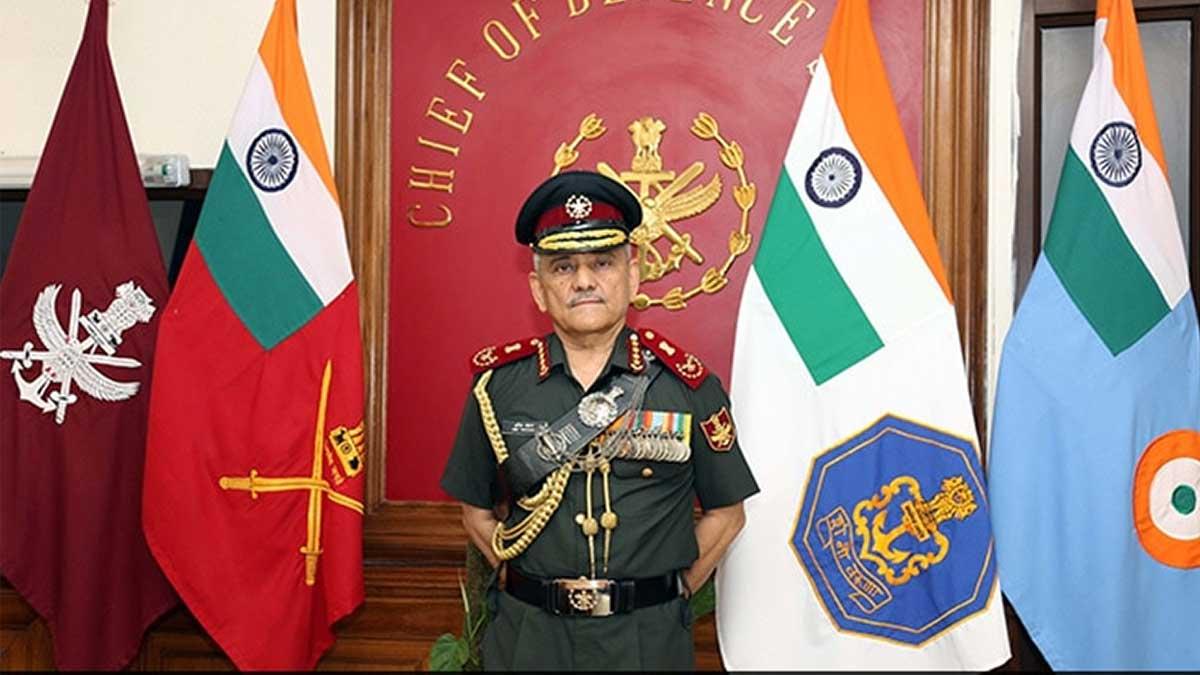


Chief of Defence Staff General Anil Chauhan on Wednesday looked back at the 1962 Sino-Indian war, saying that the deployment of the Air Force could have really stalled the Chinese advance. He said that although employing air power would have been seen as "escalatory" then, that worldview has done an about turn, as indicated by Operation Sindoor.
Referring to the war 63 years ago, General Chauhan said that the forward policy could not have been applied to both Ladakh and NEFA (North-East Frontier Agency), the modern-day Arunachal Pradesh, alike. He contended that the two had different records of disputes and completely dissimilar geographies, and therefore a single-stroke approach was faulty.
The two areas had extremely disparate histories of the dispute, disparate security environment and totally disparate terrain. In Ladakh, China had already occupied the bulk of Indian territory, while in NEFA the case of India's claim was more legitimate. To treat the two as identical and adopt identical policies was, in my opinion, slightly faulty," he said.
The CDS pointed out that over the years, the security situation as well as the nature of warfare has undergone a change. "Over the years, the security situation has changed and the face of warfare itself has got transformed," he said.
General Chauhan made these comments in a video message played during the launch of the updated autobiography of the deceased Lieutenant General S P P Thorat, Reveille to Retreat, in Pune. Lt Gen Thorat was the General Officer Commanding-in-Chief, Eastern Command, at the time the Sino-Indian war broke out. The CDS commended the autobiography as giving "valuable insights into leadership, strategy and India's military history" and being more than the memoir of a soldier.
Referring to forward policy and the lack of participation of Indian Air Force (IAF) in 1962, CDS stated, "To offer any opinion on the adequacy or inadequacy of the forward policy now is a bit challenging. Our perceptions will be colored because many reasons like geography has changed completely and so has geopolitics."
He pointed out that the strength of the forces also evolved with time. "All I can say is that the forward policy cannot have been imposed across the board on Ladakh and NEFA," General Chauhan stressed.
The two regions had very different histories of the dispute, different security context and entirely different terrain. "In Ladakh, China had already occupied much of Indian territory, whereas in NEFA the legitimacy of India's claim was stronger. To equate the two and pursue identical policies was, in my view, a bit flawed," he said. The CDS suggested Lt Gen Thorat did think about using the IAF, but the then-government did not permit such a move.
"They would have had a significant advantage during the 1962 conflict. Shorter turnaround times, a favourable geography and the ability to bring maximum payloads to bear with maximum weight on the enemy. Use of air power would have slowed the Chinese offensive considerably, if not stymied it completely. "This would have given the Army much more time to prepare. In those days, I think, the use of the Air Force was considered escalatory.
Operation Sindoor, which was carried out in May 2025, consisted of using India's air force to attack terror hotbeds in Pakistan and PoK following the April Pahalgam massacre.
General Chauhan also explained Reveille to Retreat as "not just an autobiography. It's a meditation on leadership, strategy and service. It illuminates the choices of power, criticizes them candidly and derives lessons that are for the most part as relevant today.
Reminding Lt Gen Thorat's illustrious service, the CDS said he had served in conflict areas still turbulent today in Waziristan and Peshawar in Pakistan. He possessed his battalion in Burma's Arakan (now Rakhine) state, where his command earned him the Distinguished Service Order, and thereafter participated in the legendary battles of Kohima and Imphal.
Lt Gen Thorat also commanded the Custodian Force in Korea post-Armistice and received the Ashoka Chakra Class II (now known as the Kirti Chakra) and the Padma Bhushan, General Chauhan said. "Korea remains divided along the 38th parallel, one of the world's most volatile fault lines, showing the continuity of conflict he had once helped manage," he continued.
Read also| Karnataka HC Dismisses Musk-led X Corp's Plea, Affirms Need for Social Media RegulationRead also| Centre Extends CDS Gen Anil Chauhan’s Term Until May 2026