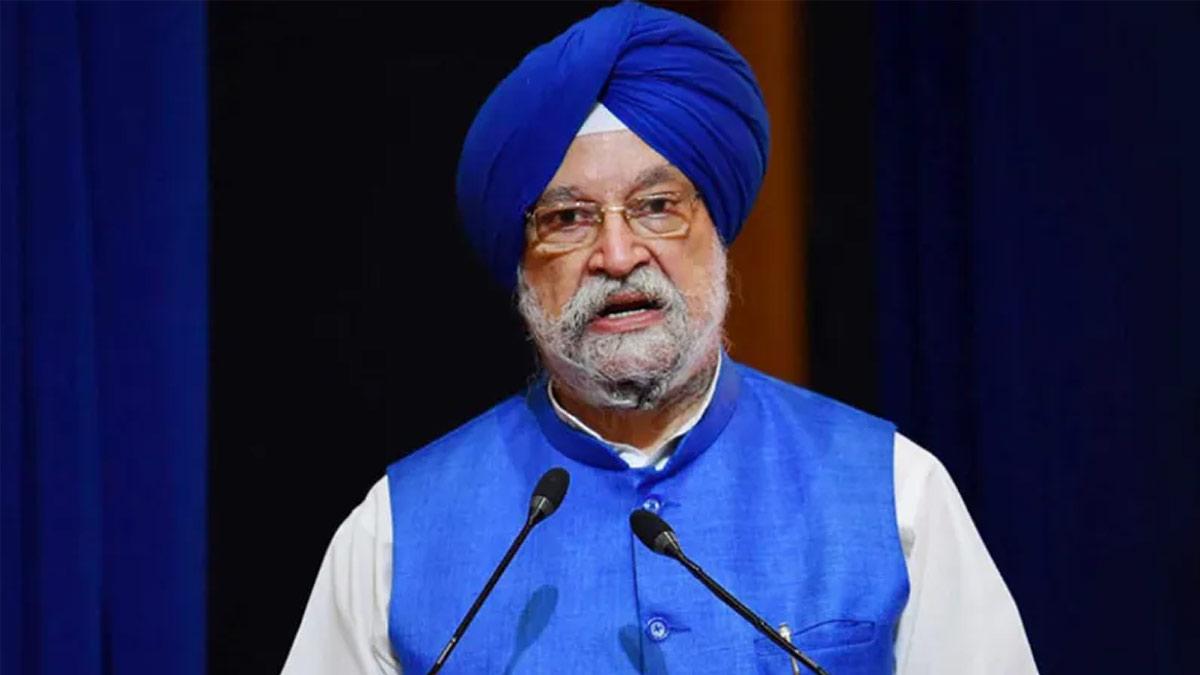


Oil Minister Hardeep Singh Puri has countered White House trade adviser Peter Navarro's "laundromat" accusations, emphasizing that India has followed international norms to the letter in its oil transactions with Russia. He contended that India's energy policy ever since the war started in Ukraine has actually ensured stability in global markets and kept prices from getting out of hand.
In a signed article for The Hindu, Mr. Puri rejected allegations of profiteering, pointing out that India has always been fourth-largest explorer of petroleum products in the world even prior to Russia's aggression in Ukraine in February 2022. He added that export quantities and refining margins have been "broadly the same" since then.
"Some critics allege that India has become a 'laundromat' for Russian oil. Nothing could be further from the truth," he wrote, without mentioning Mr. Navarro by name.
India's Russian crude share jumped from below 1 percent to about 40 percent of all imports once the conflict in Ukraine started, thanks primarily to deep discounts provided when Western nations boycotted Moscow's oil. Although this made energy cheaper for India, it also sparked criticism from the Trump camp, accusing New Delhi of importing Russian oil and exporting it to other parts of the world, including Europe.
Last week, Navarro took to X to dub the Ukraine war “Modi’s war” and claimed that New Delhi was financing President Vladimir Putin’s “war machine.”
"India's big oil lobby has turned the world's largest democracy into a massive refining hub and oil money laundromat for the Kremlin," he posted, sharing a picture of Prime Minister Narendra Modi in saffron attire.
Mr. Puri dismissed these allegations, observing that in contrast to Venezuelan or Iranian oil, Russian crude is not sanctioned.
"It (Russian oil) is under a G-7/European Union price cap system deliberately designed to keep oil flowing while capping revenues," he said. "There have been 18 rounds of such packages, and India has complied with each one."
He emphasized that India's oil business is completely transparent.
"Every transaction has used legal shipping and insurance, compliant traders and audited channels. India has not broken rules. India has stabilised markets and kept global prices from spiralling," he asserted.
Supporting this perspective, brokerage CLSA recently cautioned that if India would discontinue the import of Russian crude, the prices would rise to USD 90–100 per barrel. With India purchasing nearly 1 million barrels a day, sudden withdrawal would rock global supplies and fuel inflation, the report added.
Puri also highlighted India's historic position in world energy markets, citing that the country's refineries refine oil from various regions.
"Exports keep supply chains functioning. Indeed, Europe itself turned to Indian fuels after banning Russian crude," he said. "The volume of exports and refining margins - gross refining margins or GRMs - remain broadly the same. There is no question of profiteering."
He also added that India moved proactively to insulate the citizens from the shock of rising energy prices. "Oil PSUs absorbed losses of as much as Rs 10 per litre on diesel, the government reduced central and state levies, and export regulations required refiners exporting petrol and diesel to sell at least 50 per cent of petrol and 30 per cent of diesel in the domestic market."
"These measures, at a considerable fiscal cost, ensured that not a single retail outlet ran dry and that Indian households saw stable prices," he said.
Mr. Puri concluded by highlighting the pivotal role of Russia as the world's second-largest oil producer, meeting nearly 10 percent of global demand.
"Those who are pointing fingers ignore this fact. India's adherence to all international norms prevented a catastrophic USD 200-per-barrel shock."