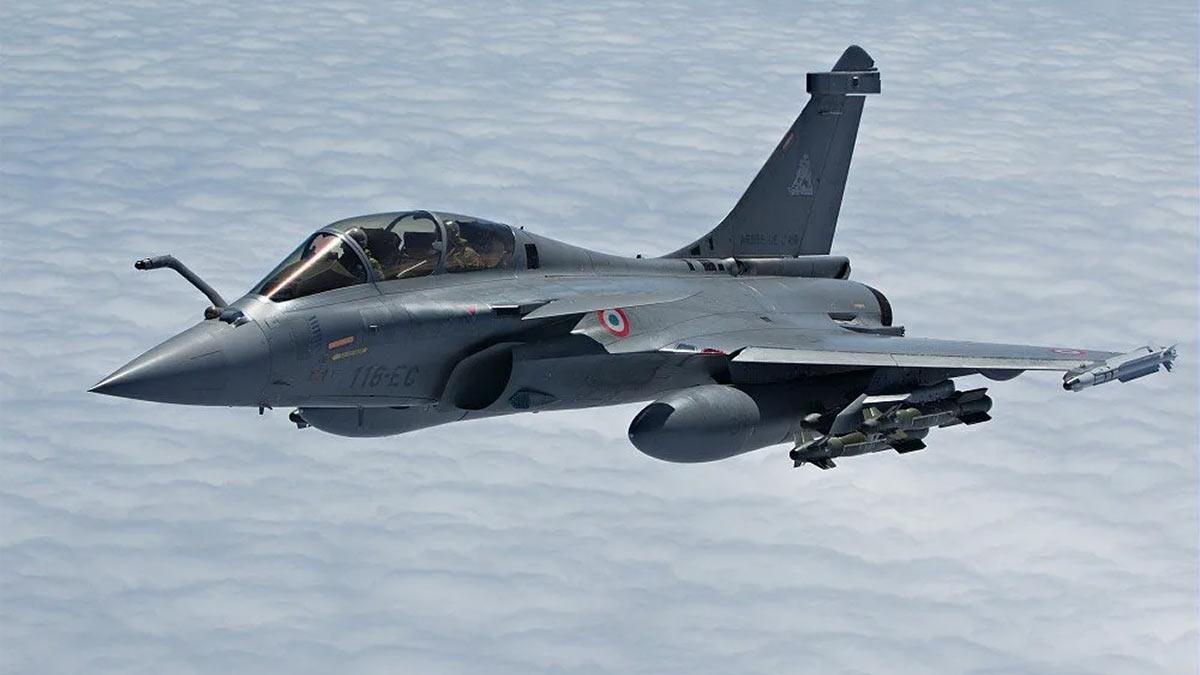


The Indian Air Force (IAF) is accelerating efforts to nail a government-to-government contract with France for additional Rafale fighter jets as part of the much-delayed Multi-Role Fighter Aircraft (MRFA) programme, The Times of India reported on Monday.
The programme intends to procure 114 aircraft, most of which are to be manufactured in India in collaboration with international vendors.
Defence sources informed the publication that the IAF is likely to table the MRFA proposal for the initial Acceptance of Necessity (AoN)—the first major milestone in defence acquisition—to the Defence Acquisition Council (DAC), led by Defence Minister Rajnath Singh, in the next few months.
"Government will make the final call when MRFA case is brought to DAC. But yes, IAF has envisioned an emergent need for more Rafales to arrest the declining number of its fighter squadrons," a source was reportedly quoted to have said.
Though finally in the hands of the government, the report pointed out that the IAF has emphasized the urgent need for additional Rafales to compensate for the drop in its operational fighter numbers.
Apart from the Rafales, the IAF has emphasized the need for buying two to three squadrons of fifth-generation jets—considering possibilities such as Russia's Sukhoi-57 or the US-produced F-35—until India's indigenous Advanced Medium Combat Aircraft (AMCA) comes on board, a target that is now scheduled for about 2035.
But the report goes on to mention that no official negotiations have been taken up with Moscow or Washington.
Officials argue that acquiring additional Rafales through a government-to-government deal under the MRFA model would be more economical, faster, and logistically viable than issuing a competitive international tender.
Base infrastructure at the Ambala and Hasimara bases—where 36 Rafales bought through a ₹59,000-crore intergovernmental agreement signed in September 2016 are deployed—can support an additional squadron each.
"Both air bases are already equipped with the infrastructure and storage facilities to host at least one additional Rafale squadron each," the source informed TOI.
The Indian Navy will also get 26 Rafale-Marine fighter jets for INS Vikrant between 2028-2030 under a ₹63,887-crore agreement inked in April with France. This addition, the report added, would improve interoperability and simplify logistics among India's military forces.
The decision aligns with suggestions from a recent high-level panel, headed by Defence Secretary Rajesh Kumar Singh, to speed up the modernisation of the IAF by involving the private sector more in collaboration with the DRDO and state-run defence firms.
The renewed drive for Rafales comes after Operation Sindoor (May 7-10), during which the fighter planes conducted deep penetration precision strikes across the Pakistan border.
Pakistan asserted it had destroyed six IAF planes, three of which were Rafales—a repudiation India has strongly denied. Pakistan used Chinese J-10 planes equipped with PL-15 long-range air-to-air missiles in the operation that could target targets up to 200 km away.
Currently, the IAF operates 31 fighter squadrons, each with 16–18 aircraft. This is expected to fall to a record low of 29 with the retirement of MiG-21 fleet later this month.
As per TOI, this is far below the approved strength of 42.5 squadrons required to counter China and Pakistan's simultaneous threats—particularly when it is being speculated that China will be providing Pakistan with some 40 J-35A fifth-generation stealth aircraft in the near future.