
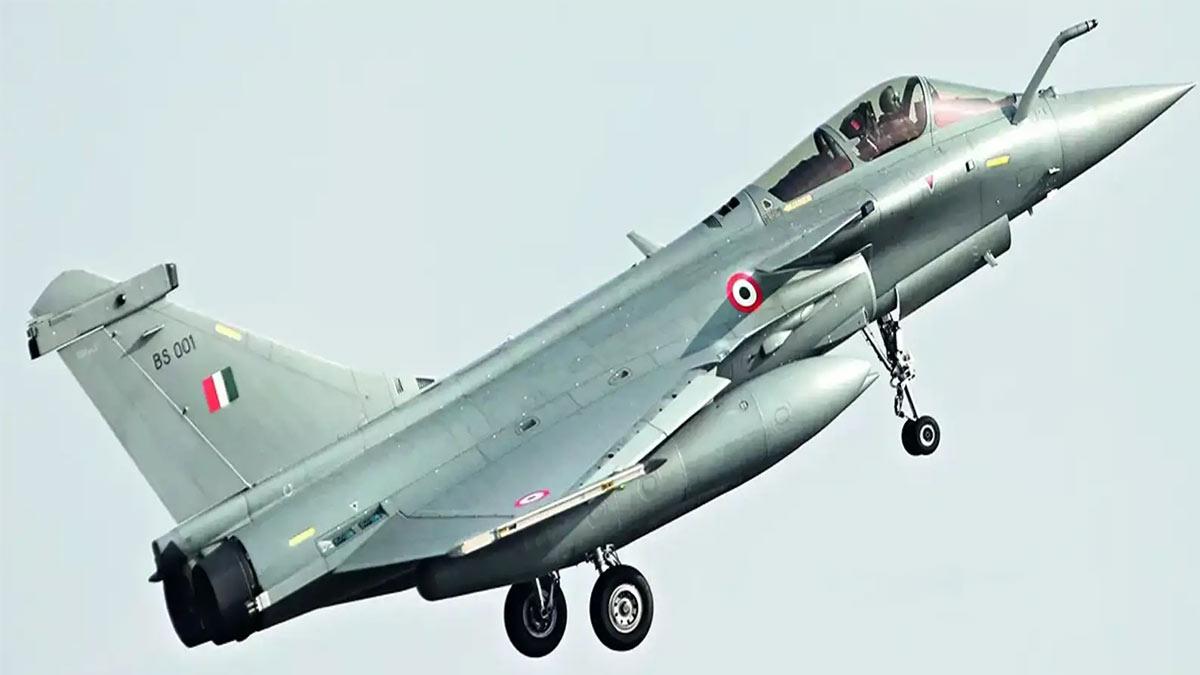


India is speedily procuring Israel's advanced X-Guard electronic decoy system to improve the survivability of its Rafale fighter squadrons, specifically through defence sources.
The decision has been made in the wake of increasing turbulence in West Asia following reported battlefield success by the system in Operation Sindoor in May 2025.
Designed by Rafael Advanced Defence Systems, the X-Guard fibre-optic towed decoy is a cutting-edge electronic warfare system designed to protect combat aircraft from contemporary radar-guided missile systems.
Deployed within the Rafale's electronic package, X-Guard greatly improves in-flight survivability as it actively jams enemy radars, thus neutralising tracking and targeting functionality within hostile areas.
The Indian Air Force’s decision to speed up the procurement follows the system’s acclaimed performance during recent operations. Defence reports highlight that X-Guard played a pivotal role in Operation Sindoor by effectively misleading Pakistani air defence systems. Commenting on its impact, former U.S. Air Force pilot Ryan Bodenheimer said it was “the best spoofing and deception we’ve ever seen” and noted that it may have “redefined the rules of electronic warfare.”
At a weight of approximately 65 kilograms, the X-Guard is carried in a pod on an aircraft hardpoint. When deployed, the system deploys a towed decoy through a 100-meter fibre-optic cable that transmits a 500-watt, omnidirectional jamming signal. Using AI-powered algorithms, the system dynamically adapts in real-time to replicate Mach 1 Doppler signatures, creating realistic decoys that deceive radar-guided threats.
The urgency for India's request corresponds with major bottlenecks in Israeli defence production. Rafael, along with other main Israeli defence corporations, is presently coping with more than $1.5 billion in delayed deliveries as a result of changing domestic priorities.
The major contributors to the slowdown in production are:
Domestic Prioritisation: Israeli defence producers are prioritising equipping their own military forces amidst regional conflicts.
Manpower Gaps: Numerous skilled personnel have been mobilised for military service, leading to severe shortages of labour.
Shortages of Materials: Raw materials are being redirected to meet pressing Israeli defence needs.
In addition, the wider conflict in the region has disrupted global shipping lanes, with shipping across the Red Sea dramatically curtailed. Shipments are therefore being diverted around the Cape of Good Hope at Africa, adding up to 10 days to transit times and raising costs of logistics.
India's attempt to arm its Rafales with the X-Guard system is a broader initiative to build air capabilities to counter changing regional threats. Rafales carried out precision strikes with SCALP long-range missiles and AASM Hammer guided bombs during Operation Sindoor. Operations also highlighted India-specific improvements like helmet-mounted sights and infrared search-and-track (IRST) systems optimized for regional theatres.
The success of the X-Guard in combat operations was seen through:
Missile Evasion: The decoys deceived PL-15E air-to-air missiles, which did not lock onto the true Rafales.
Radar Disruption: Next-generation AESA radars such as the KLJ-7A, used by Pakistani J-10C aircraft, were said to be baffled by the spoofing system.
Mission Assurance: The decoy system was instrumental in saving aircraft while maintaining strike targets.
India's move to give high priority to the acquisition of X-Guard is a reflection of its commitment towards keeping a cutting-edge position in aerial warfare. The success of the system also reflects the increasing strategic and defence relationship between India and Israel, which has emerged as a key partner in the supply of high-technology military hardware.
Concurrently, this advancement is in concert with India's long-term defence strategy, such as improving indigenous strength through projects like the new Hyderabad Rafale fuselage manufacturing facility.
In the near future, the induction of X-Guard is set to bring:
Increased Deterrence: Improved survivability of front-line fighters operating in high-threat environments
Technological Maturity: A standard in operational implementation of AI-based electronic warfare
Operational Agility: Enhanced confidence in conducting operations in adverse electronic threat environments
India's rapid shift to acquire X-Guard technology is testament to a flexible and visionary defence policy, one which aims to reconcile short-term tactical requirements with long-term security strategies in an increasingly unstable global politico-strategic environment.
Read also| IIM‑Calcutta Student Allegedly Drugged and Raped in Boys’ Hostel; One Held