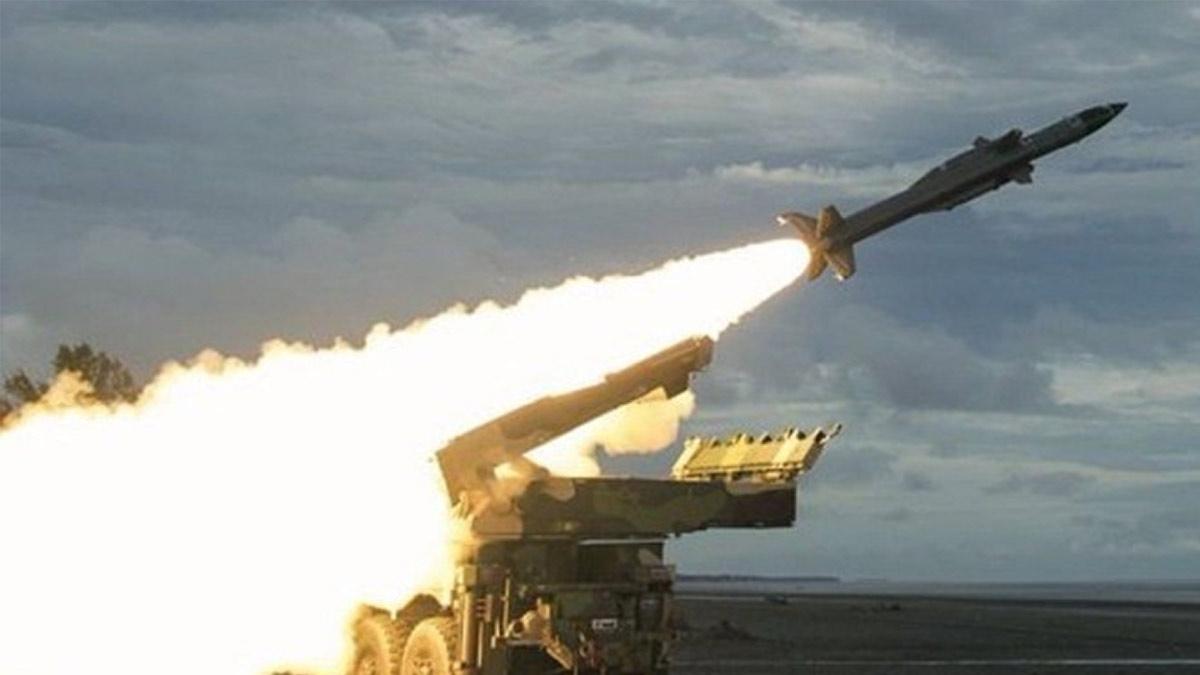


In a major boost to its air defence capability, India successfully conducted a high-altitude test of the indigenously designed 'Akash Prime' air defence system on Wednesday.
The Indian Army carried out the live test at an altitude of about 15,000 feet in the difficult terrain of Ladakh.
The Akash Prime system, developed by the Defence Research and Development Organisation (DRDO), was tested under the watchful eyes of senior officers of the Army's Air Defence Corps and DRDO scientists, which is a significant milestone for India's quest towards a self-sufficient defence environment.
During the test, surface-to-air missiles of the system engaged and destroyed two high-speed aerial targets with high accuracy. The operational performance of the system in thin air and severe environmental conditions justified its reliability in operations for high-altitude warfare.
India's defence sources confirmed that the Akash Prime system will be deployed in the Indian Army's third and fourth Akash Regiments, thus strengthening the air defence architecture of the nation.
The Akash system earlier proved its worth in use under the Operation Sindoor, when it was used to intercept and drive away air threats from Chinese fighter jets and Turkish-built drones employed by Pakistani forces.
Defence analysts consider the success test as a demonstration of India's increasing capability for indigenous military technology and a significant boost in its aerial threat-response preparedness.
In a simultaneous step to decrease foreign reliance in areas of core defence, the Ministry of Defence organized a Workshop and Exhibition on Unmanned Aerial Vehicles (UAVs) and Counter-Unmanned Aerial Systems (C-UAS) in New Delhi on Wednesday.
Organised by the Headquarters Integrated Defence Staff (HQ IDS) in association with the Centre for Joint Warfare Studies (CENJOWS) at the Manekshaw Centre, the event's major aim was the indigenisation of essential components that are presently being procured from foreign Original Equipment Manufacturers (OEMs).
This effort acquires greater importance in the wake of Operation Sindoor, which emphasized the operational significance of UAVs and C-UAS systems in actual combat. These technologies played a decisive role in real-time information gathering, conducting precision strikes, and guaranteeing soldier safety —highlighting the maturity of indigenous defence R&D in operational environments.
The parallel emphasis on high-altitude missile defense and indigenous UAV development mirrors India's overall strategic orientation towards defence self-reliance and survivability in contemporary conflict.