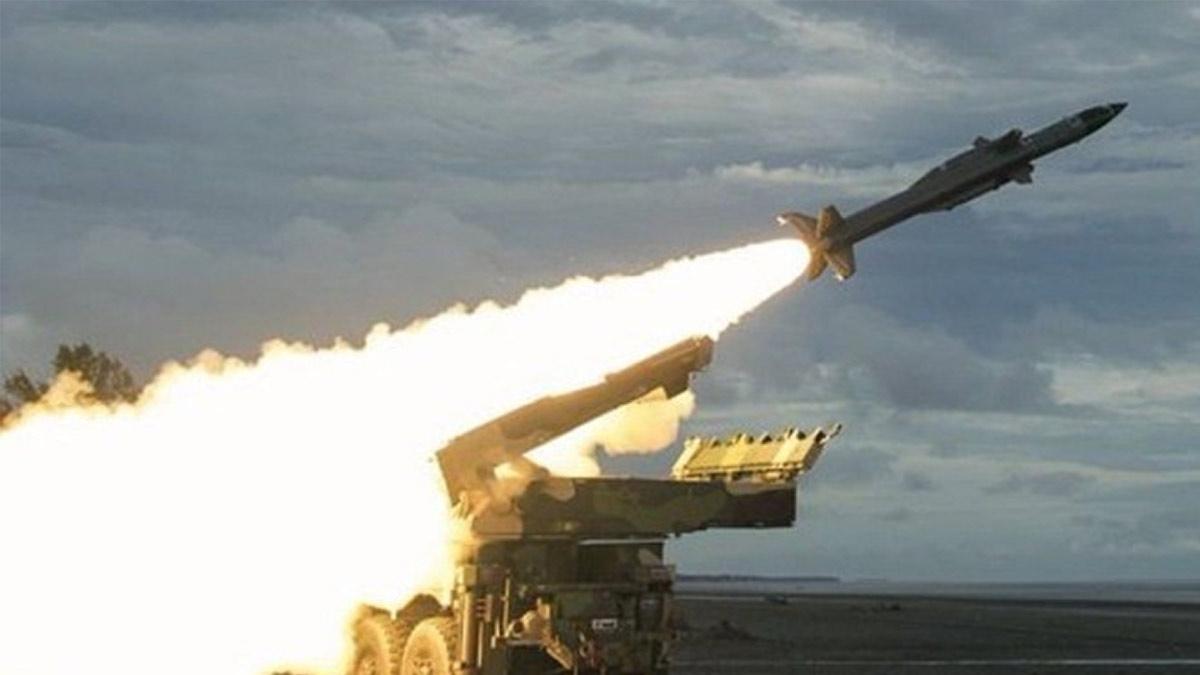


In a significant step for India's indigenous air defence capabilities, the Indian Army has successfully conducted high-altitude trials of the Akash Prime surface-to-air missile system in the strategically sensitive Ladakh sector, defence officials informed news agency ANI on Wednesday.
The test, which was carried out at altitudes in excess of 15,000 feet, was carried out by the Army Air Defence Corps in collaboration with top scientists from the Defence Research and Development Organisation (DRDO), which had designed the missile.
The system scored two direct hits on high-speed aerial targets during the trial, even under the thin atmosphere and difficult terrain of the high-altitude range.
Akash Prime system proved its operational capability by achieving two direct hits on high-speed target aircraft flying at challenging high-altitude conditions," officials told ANI.
Akash Prime is a major improvement over the base version of the Akash missile system. Equipped with an upgraded seeker and sophisticated targeting technology, it is intended to provide greater precision in adverse weather conditions and challenging terrain. The system can also detect and destroy multiple airborne targets at a time.
Authorities confirmed Akash Prime had already been operationally deployed during Operation Sindoor when it was used to repel aerial threats from Pakistan, which included Chinese-made planes and Turkish drones.
The successful test in Ladakh further vindicates the missile's performance capabilities and takes forward its proposed induction into the Indian Army's tiered air defence system. Sources said that subsequent regiments—particularly the third and fourth Akash regiments—are set to be outfitted with this new version.
The development is in line with India's overall strategy of self-reliance in vital defence technologies, particularly in air defence systems. Akash Prime is a central part of this indigenous initiative, increasing the country's ability to neutralize changing aerial threats.
The Akash air defence system has already proved instrumental in enhancing border security. Defence sources made the revelation on Thursday that the system was crucial in countering a number of drone threats by Pakistan along the western border and the Line of Control (LoC) in Jammu and Kashmir.
The Akash is a medium-range, surface-to-air missile platform capable of providing protection against a range of airborne threats. It can defend mobile, semi-mobile, and static installations, and its architecture supports both autonomous and networked operations.
Employing phased array radars and real-time multi-sensor processing, the system controls missiles via command-based guidance to successfully destroy threats from any direction. Its flexibility has meant that it has been widely used by both the Indian Army and Air Force, particularly in areas bordering Pakistan.
On the evening of May 8–9, 2025, the Indian Army foiled a series of drone attacks and ceasefire breaches initiated by Pakistani troops along the LoC and the international border.
"Pakistan Armed Forces conducted repeated attacks with drones and other weapons on the entire Western Border on the night of May 8-9, 2025. Pakistani forces also indulged in repeated ceasefire violations on the LoC in Jammu and Kashmir. The drone attacks were successfully repelled and a befitting response was provided to the ceasefire violations," the Indian Army said.
According to information quoted by ANI, over 50 Pakistani drones were shot down in a major counter-drone operation.
Indian Armed Forces also neutralised attempts to strike several military bases in north and west regions last night, May 7–8. In one such case, an enemy air defence installation in Lahore was apparently destroyed.
The Akash Prime's performance at high altitudes, along with its combat track record, highlights its new status as a key pillar of India's defense policy and the nation's increasing self-reliance in advanced missile technology.
Read also| Indian Army Set to Bolster Firepower with Induction of US Apache Helicopters Next Week