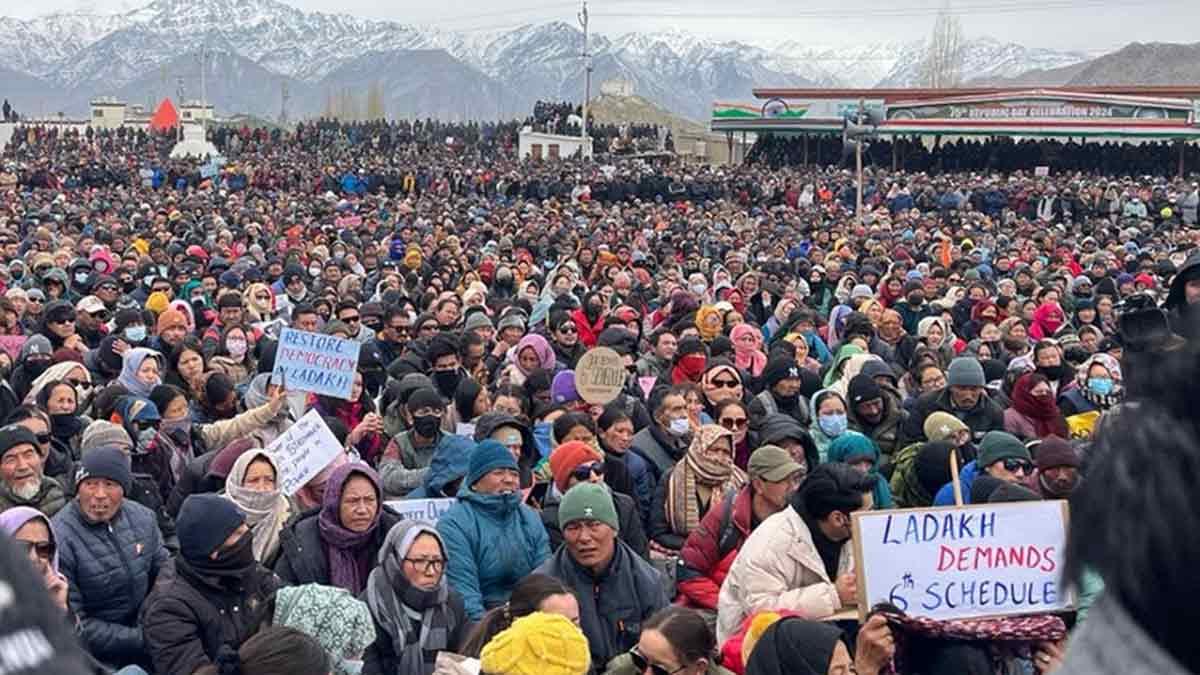


Four individuals were killed and numerous others were injured in bloody confrontations between protesters and security personnel during the Leh Apex Body-supported shutdown in Leh town, Ladakh, on Wednesday, officials said.
Police had to resort to firing to disperse the crowds after protesters, pressing for statehood for Ladakh and the implementation of the Sixth Schedule, unleashed large-scale violence, vandalising a BJP office and a number of vehicles.
Violence erupted earlier in the day when protesters fought with police, pummeling them with stones and torching a police car—the first large-scale eruption of violence in the continuing statehood movement. Hundreds of protesters marched through the streets, calling for statehood and constitutional protections, while sitting out a hunger strike and imposing a full shutdown to make their demands known.
In the midst of the commotion, demonstrators burned down the Ladakh BJP headquarters, hurled stones at police, and incinerated a police car. Police responded by using tear gas and batons to scatter the unruly crowd.
The authorities observed that these massive clashes were unprecedented in recent memory in Ladakh. The violence is a prelude to talks with the government, as the Centre has scheduled a meeting on October 6 with Ladakh representatives to resume discussions on the demands of the region.
For the last fortnight, climate activist Sonam Wangchuk has been protesting on a hunger strike in Leh demanding statehood and the inclusion of Ladakh under the Sixth Schedule of the Constitution.
For the last three years, discontent has risen among Ladakhi residents against direct central rule, with repeated demands for statehood and constitutional protection to save their land, culture, and resources.
Ladakh was created as an independent Union Territory in August 2019, after Article 370 was revoked and the erstwhile state of Jammu and Kashmir was bifurcated. At first, most in Leh, including Wangchuk, had greeted the change. But within a year, there were fears expressed about what people termed as a political vacuum in the government run by the Lieutenant Governor.
This growing discontent resulted in mass protests and hunger strikes. For the first time, political and religious parties from Buddhist-majority Leh and Muslim-majority Kargil came together under a common platform: the Apex Body of Leh and the Kargil Democratic Alliance.
Rebellion being staged against the Centre, the Centre constituted a high-level committee to consider Ladakh's demands, but several rounds of negotiations proved futile. In March, Ladakh representatives met Union Home Minister Amit Shah in Delhi, but the negotiations broke down, with local leaders saying that their major demands were rejected by the Home Minister.
"During the meeting, the Home Minister told us that he had made a mistake by carving out Ladakh as a separate Union Territory. He also rejected our demand for statehood and the Sixth Schedule," a leader who attended the meeting told NDTV.
Read also| 8 Bombs Dropped by Pak Air Force Kill 30 in Khyber Pakhtunkhwa Village