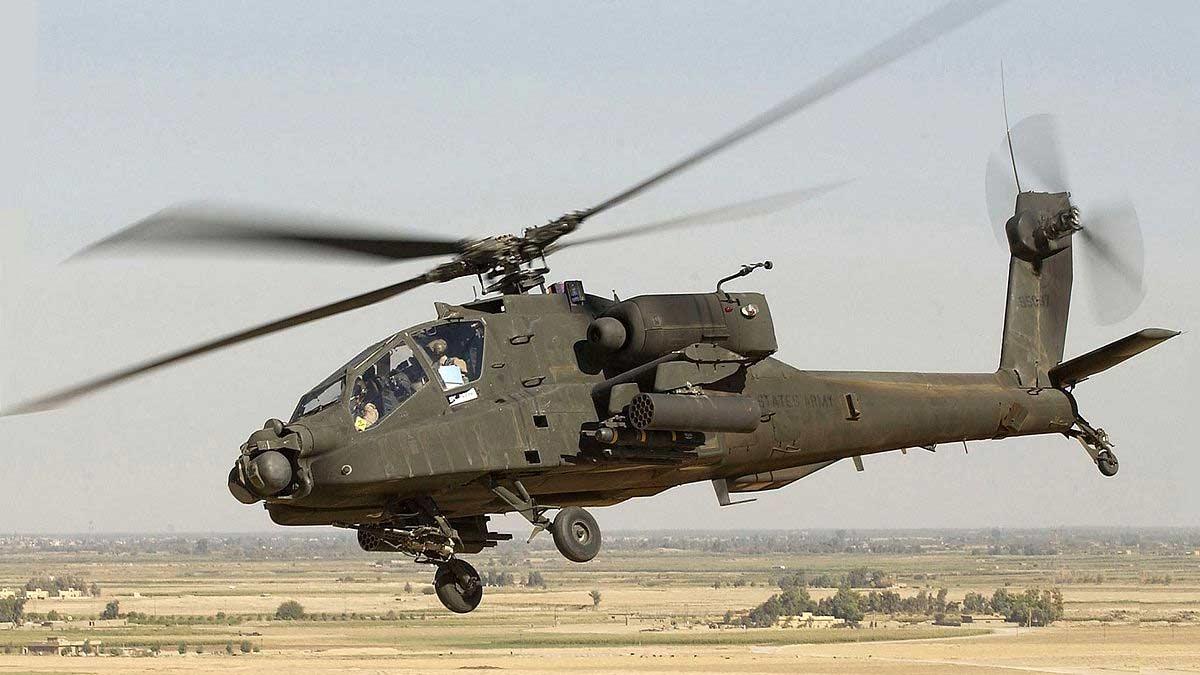


The Indian Army is to receive three AH-64E Apache attack helicopters on July 21 from the United States, according to NDTV.
These advanced combat helicopters will be stationed near the Pakistani border, enhancing India's offensive strike power and aerial surveillance efforts. The helicopters are due to land at the Hindon Air Force Station in Ghaziabad.
Dubbed "Tank Killers" or "Tanks in the Air," the Apache is generally regarded as the most sophisticated attack helicopter ever to enter service in the world. This delivery has been held up because of worldwide supply chain disruptions and changing geopolitics. It arrives over 15 months since the Indian Army commissioned its first Apache helicopter squadron in Jodhpur, Rajasthan.
India's relationship with the Apache was initiated by a 2015 agreement between the Indian Air Force, the US government, and Boeing to buy 22 helicopters, which were all delivered by July 2020. India signed another $600 million contract later in the year to buy six more Apaches designed for the Army.
These three choppers are under that second deal, the initial delivery period of which—May to June 2024—has been postponed. Its first batch is now going to reach the Indian Army later than anticipated.
Defence Minister Rajnath Singh has recently talked to US Secretary of Defence Pete Hegseth regarding the delayed Apache delivery. Singh pointed out how urgent it was to provide Apache supplies and, at the same time, pressed for GE F404 engines for India's indigenous Light Combat Aircraft, Tejas. Terming the meeting as "excellent," Singh revealed that the talks were focused on enhancing the India–US defence cooperation.
A 2022 internal Army report estimated a long-term need for 39 Apache helicopters, highlighting their key importance in the modernization of the Army Aviation Corps.
Aside from the Apache, the Indian Army utilizes different rotary-wing assets for diverse missions. The Rudra, which is an armed version of the HAL Dhruv, is mainly utilized in anti-tank and close support operations. Meanwhile, light helicopters like the Cheetah and Chetak are still engaged in critical tasks of casualty evacuation, supply missions, and aerial reconnaissance in challenging terrain.
India is also heavily investing in indigenous development. The indigenously designed Light Combat Helicopter (LCH) Prachand is well-suited to high-altitude operations and combat. In March 2025, the Ministry of Defence inked deals worth ₹62,700 crore with Hindustan Aeronautics Limited (HAL) for the production of 156 LCH Prachands—90 for the Army and 66 for the Air Force.
With India increasingly prioritizing the bolstering of its defense forces through the use of foreign and indigenous platforms, the Apache helicopters represent another key move towards advancing frontline capability and technological dominance.
Read also| Indian Army Set to Bolster Firepower with Induction of US Apache Helicopters Next Week
Read also| India Acquires GE-404 Engine from US for HAL’s LCA Mark 1A Fighter Jet Program