

Almost a month since the killer Air India crash in Ahmedabad killed more than 270 people, an initial probe into one of India's worst aviation disasters in decades has revealed that both the fuel control switches on the engines were shifted from 'RUN' to 'CUTOFF' only seconds after take-off.
The results emerged in a 15-page preliminary report published early on Saturday by the Aircraft Accident Investigation Bureau (AAIB), which is investigating.
The cockpit voice recorder picked up a frightening conversation between the pilots. "Why did you cut off?" one of them inquired. The second pilot insisted that he had not done it.
The CUTOFF switch—used to shut off fuel flow to the engines—has been identified as a potentially decisive contributor to the disastrous chain of events of the Boeing 787-8 Dreamliner, which was about to take off for London on June 12.
As per the Enhanced Airborne Flight Recorder (EAFR) data, the switches were immediately turned back to 'RUN' soon after the engines had been shut off, implying an effort on the part of the pilots to regain control. Planes like the 787 Dreamliner are designed to maintain a safe takeoff even in the event of an engine failure, and pilots are intensively trained to recover from such a situation.
"When fuel control switches are initialized from CUTOFF to RUN during flight, each engine's full authority dual engine control (FADEC) will automatically execute a relight and thrust recovery sequence of ignition and fuel introduction," the report said.
Yet the EAFR recording cut off only seconds after the switches were reset. One of the pilots was able to send a MAYDAY call over the distress system, but air traffic control's request to acknowledge the flight's call sign was met with silence. It was only seconds later when the plane crashed just beyond the airport grounds.
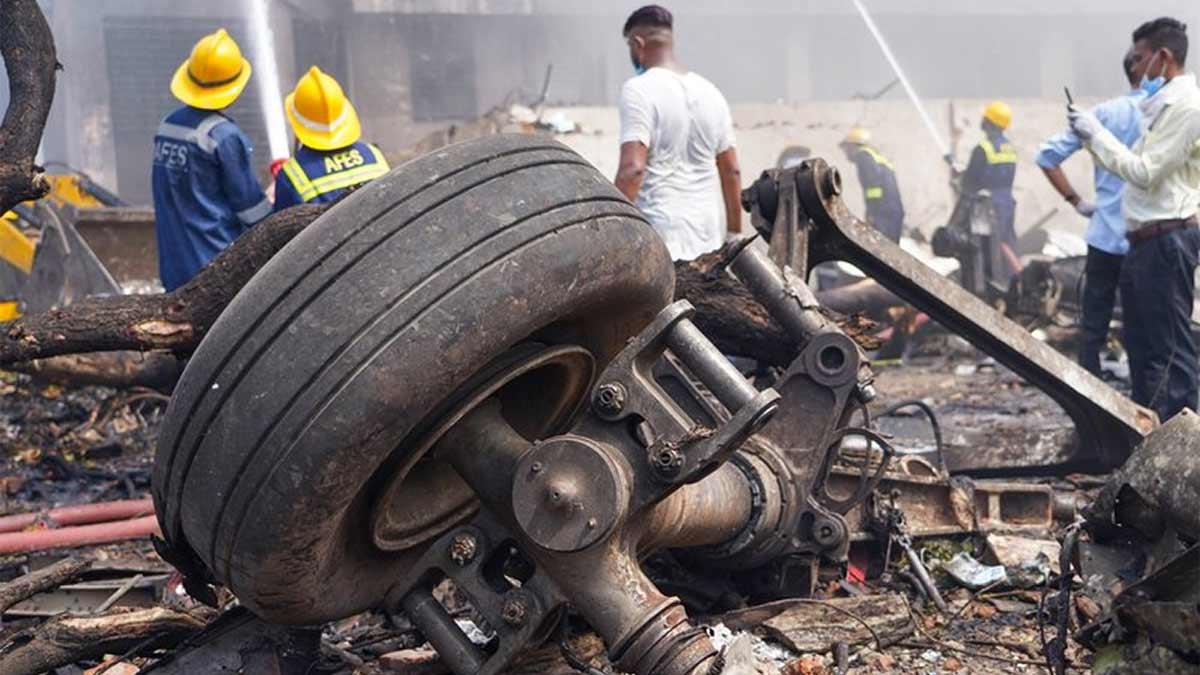
The plane, carrying its full fuel load for the overseas flight, quickly dropped in altitude and crashed into a hostel of medical students, causing a raging explosion that killed all but one of the 242 individuals on the flight and inflicted about 30 ground casualties. The flight was just 32 seconds long.
Captain Sumeet Sabharwal, a Line Training Captain of more than 8,200 flying hours, was in charge, supported by First Officer Clive Kundar, who had 1,100 flying hours. The pilots were said to be healthy, rested well, and qualified to fly the flight, the AAIB reported.
Even though the report revealed no immediate indication of foul play, it did mention a Federal Aviation Administration (FAA) advisory related to possible problems with fuel control switches. The advisory pointed out that certain Boeing 737 aircraft were found to have fuel switches with the locking feature disabled. "The concern was not considered an unsafe condition," the report explained.
Additional CCTV footage from an airport provided additional proof that the plane's Ram Air Turbine (RAT), or standby power system usually brought into use during double engine or total loss of power, was engaged shortly after takeoff.
"Any notable bird activity in the flight path area is not seen. The plane began losing altitude before clearing the perimeter wall of the airport," read the report.
A comparable but less fatal accident took place in the 1980s, when a Delta Air Lines pilot accidentally cut fuel to both engines of a Boeing 767. That plane, at a higher altitude, was successfully recovered without loss of life.