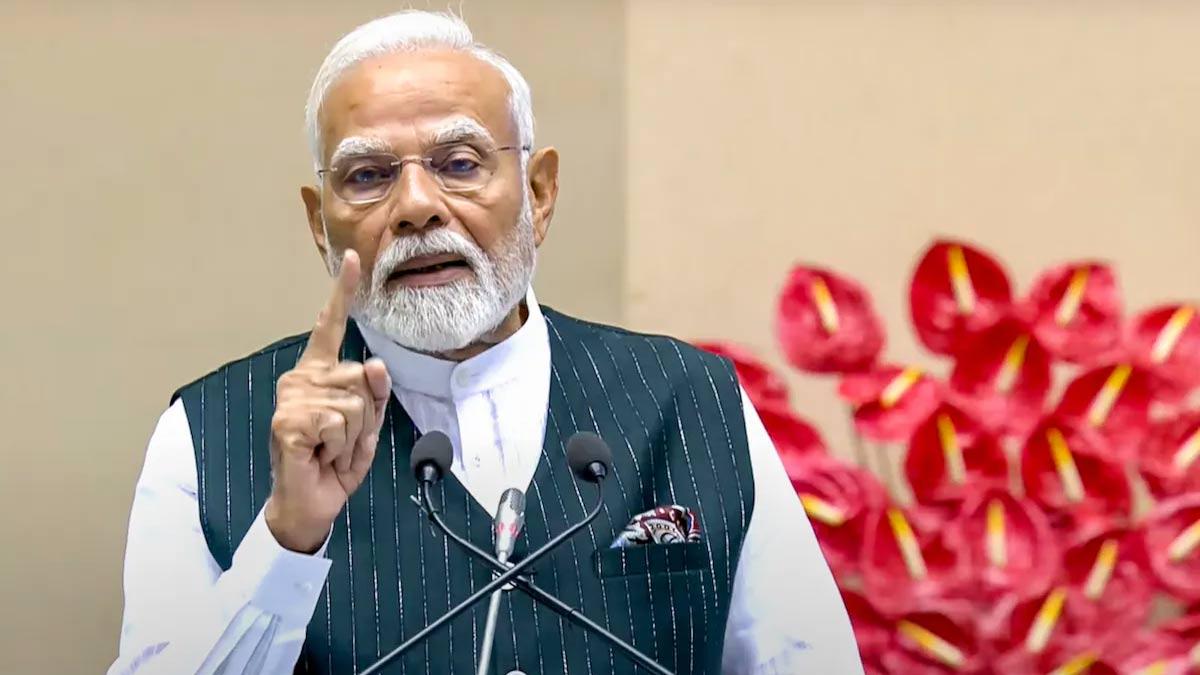


Only a day after U.S. President Donald Trump ratcheted up the tariff war against India, Prime Minister Narendra Modi sent a strong message, reiterating that India would never compromise on safeguarding the interests of its farmers and fishermen.
In an acknowledgement of the political and diplomatic expenses of taking this line, the Prime Minister announced he was willing to accept them in the interest of the country's farmers.
In his address at the MS Swaminathan Centenary International Conference organized in New Delhi, PM Modi said, "The interest of farmers is our highest priority. India will never make a trade-off with the interests of its farmers, livestock owners, and fishermen. And I know that I have to pay an enormous price for this personally, but I am prepared. India is prepared, for the country's farmers, fishermen and livestock owners." His statement came just days after Trump's new tariff actions went into effect.
In a tribute to MS Swaminathan, the grand old man of India's Green Revolution, Modi underlined the necessity to shift from food security to something more holistic. "On the shoulders of the success of food security, the new challenge for our agricultural scientists is making the world nutritionally secure," he said.
Agricultural exports are a significant portion of India's trade with America, and the industry will take a big hit under Trump's new tariffs.
Yesterday, President Trump declared a further 25 percent duty on Indian imports, blaming India for its continued imports of Russian crude oil. This follows the imposition of an identical 25 percent duty last week on July 20, which doubled the rate to 50 percent.
India's Ministry of External Affairs retaliated sharply, terming the tariff increase as "unfair, unjustified, and unreasonable." The ministry reaffirmed that India's energy policy is determined by the market situation and the necessity to attain inexpensive fuel for its large population. "We have already explained our stand on these matters, including the basis that our imports are market-driven and made with the overall aim of securing the energy security of 1.4 billion Indians.". It is thus very unfortunate that the US should decide to increase tariffs on India for things that some other countries are doing as well in their own national interest," the ministry stated, going on to say that India "will take all necessary actions to defend its national interests."
Relations between the two countries have been strained ever since India conducted Operation Sindoor when there was a terrorist strike in Jammu and Kashmir's Pahalgam area, killing 26 civilians. President Trump has been taking credit time and again for brokering a ceasefire between India and Pakistan, which has been firmly denied by the Indian government. "We had said from day one that our action was non-escalatory.". No world leader told us to halt Operation Sindoor, Modi had stated in a parliament discussion on the operation. The tariff action has been interpreted by some as a retaliatory action after these events.
Compounding this is the impasse in bilateral trade talks between India and the United States. Washington has been seeking increased access to Indian agriculture markets—a call New Delhi has consistently rebuffed in a bid to defend its agricultural sector.
Read also| Trump tariff actions 'unfair, unjustified', national interest top priority, says India