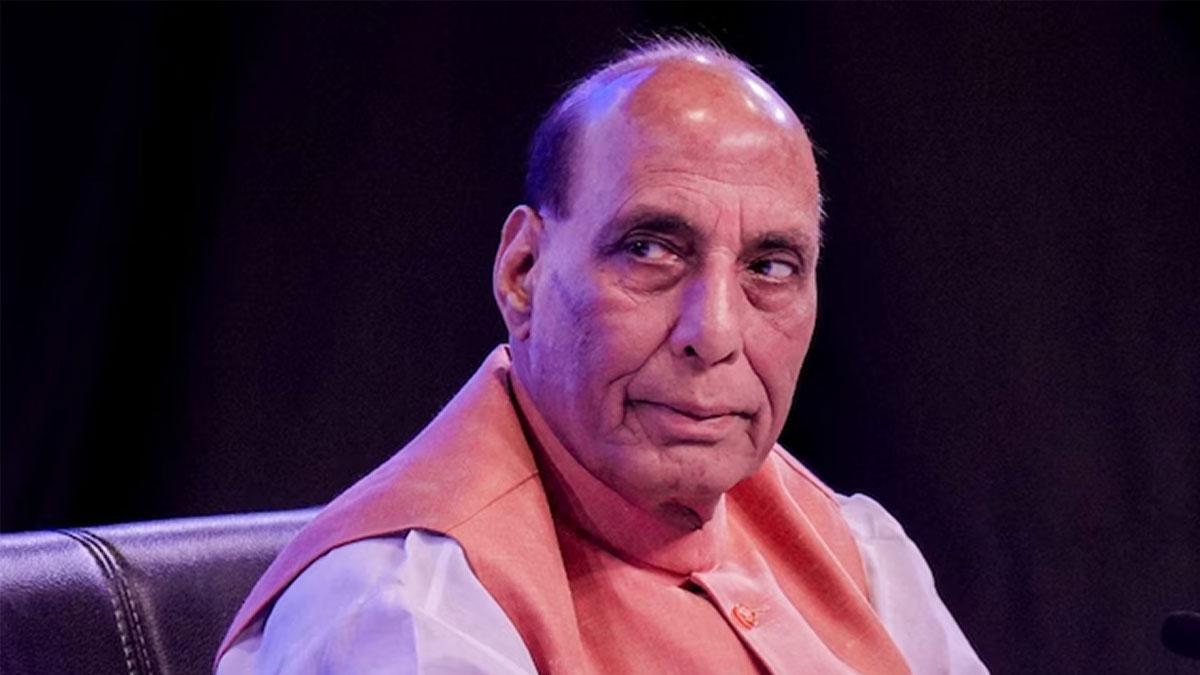


Defence Minister Rajnath Singh on Wednesday once again asserted that India never was and never will be a country that looks for war or starts aggression, but he also cautioned that any attempt to challenge the nation would be dealt with firm strength.
Addressing the 'Ran-Samwad 2025' Tri-Service Seminar hosted by the Army War College in Mhow, Madhya Pradesh, Singh underlined the importance of continuously enhancing defence preparedness to counter new threats.
"The name of the programme, Ran-Samwad, itself seems rather intriguing. On the one hand, 'Ran' reminds one of war and fight, and on the other hand, 'Samwad' suggests dialogue, discussion, and reconciliation," he stated.
"On the face of it, the two words appear contradictory. Where there is a war, how can there be a dialogue, and where dialogue is going on, how can there be a war? But if you see below the surface, this very name reflects one of the most pertinent realities of our times," Singh said, making a reference to the Mahabharat.
The seminar, which was the first of its kind, had the three wings of the military come together to deliberate on the place of technology in warfare in the modern era. Chief of Defence Staff General Anil Chauhan, Chief of the Air Staff Air Chief Marshal A.P. Singh, and Chief of Naval Staff Admiral Dinesh Kumar Tripathi were present.
Reiterating India's long-held position, Singh added, "India never was a country that looks for war. We have never launched aggression against any body. But the current geopolitical scenario is very different. Though we do not have any aggressive intent, if someone provokes us, it becomes necessary that we retaliate strongly. In order to do that, we need to always upgrade our defence preparedness. That's why training, technological upgradation and consistent engagement with allies are of critical significance for us."
Emphasizing the change in modern conflicts, Defence Minister noted, "Today, in the 21st century, this change has become all the more speedy. Soldier numbers or the quantities of weapon depots are no longer sufficient. Cyber Warfare, Artificial Intelligence, Unmanned Aerial Vehicles and Satellite-based Surveillance are defining future wars. Precision-guided munitions, real-time intelligence and data-driven information have now emerged as the foundation for victory in any war."
He went on to say that warfare today is not just confined to land, sea, and air but reaches outer space and the cyber world as well. "Thus, what we need today is not only defensive preparedness but also a proactive approach," Singh said, adding that satellite networks, anti-satellite missiles, and space command centers are now critical "instruments of power."
Labeling technology, intelligence, economy, and diplomacy as the essential drivers of future conflicts, he stated, "Future wars will not be just wars of weapons, they will be a combined play of technology, intelligence, economy and diplomacy. In the days to come, the country which dominates the triangle of technology, strategy and adaptability will be the real world power. In short, this is the time to learn from history and write a new one; this is the time to foresee the future and create one."
Read also| ECI Invites Public Opinion on Five Key Questions Amid Bihar ‘SIR’ Controversy
Read also| Watch | India Has Power of Democracy and Advantage of Demography: PM Modi