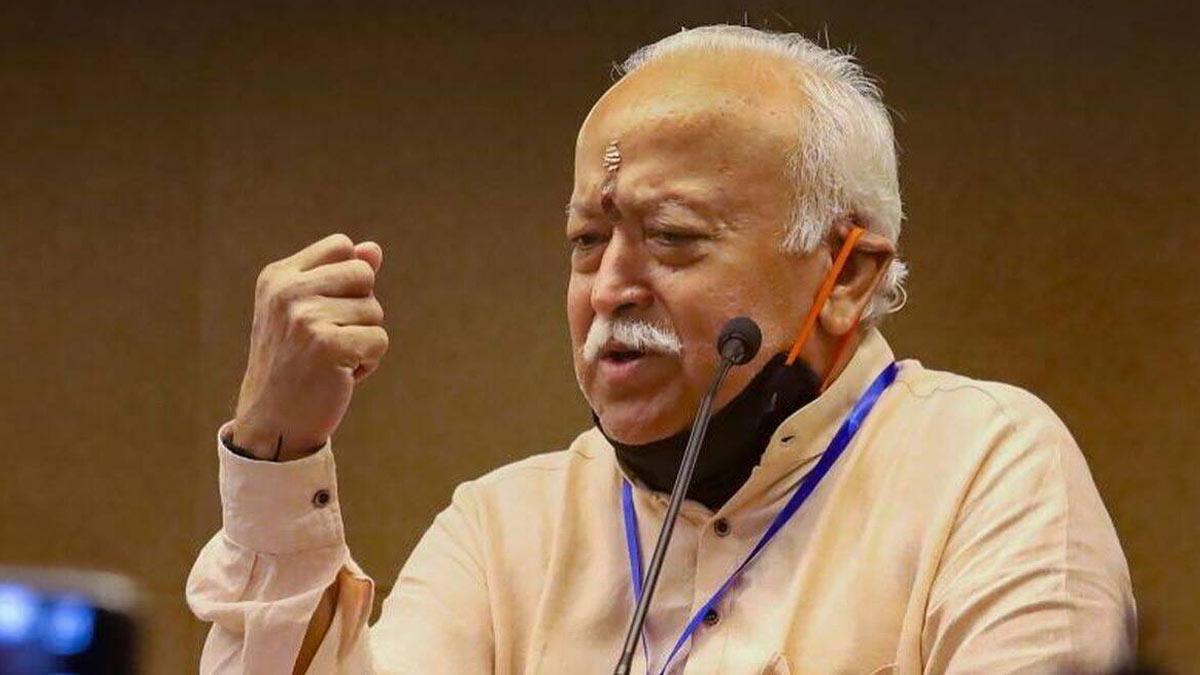


Rashtriya Swayamsevak Sangh (RSS) president Mohan Bhagwat on Tuesday explained that a Hindu Rashtra cannot be interpreted by the lens of the Western nation-state. It is neither politics nor power, he said, but it is egalitarian to the core, without segregation on the basis of religion or language.
He also emphasized the autonomous nature of Sangh and its independence from the government, claiming that though debates are taking place on "Achar, Vichar, Sanskar" (behavior, ideology and values), the organization never forces its opinion on anyone. Although he didn't refer to any political party by its name, everybody is widely convinced that he was talking about the Bharatiya Janata Party (BJP). Though the Sangh keeps itself at arm's length from electoral politics, it is also considered to be the BJP's ideological core, shaping its strategies, policies, and organisational moves.
Addressing the first day of the three-day lecture series 'New Horizons' held during the Sangh's centenary celebrations, Bhagwat again asserted that the RSS, which has been subjected to "challenges and false charges" in the past, was not formed as a response to any group or incident.
"Sangh was not a party to any protest or opposition. when somebody asked Guruji (MS Golwalkar; the man who constructed the organisation) why there had to be a Sangh Shakha in regions where there were no Muslims or Christians, he replied that there would be a Hindu Samaj and a Shakha even if there were no Muslims on this earth," Bhagwat said.
He stressed inclusiveness, saying, "We do not believe in unity from uniformity. There is no Hindu versus others. Inclusivity has no outer limit. We can have mathed (differences of opinion) not manbhed (discord). Even those who oppose us are our own."
Bhagwat further said the DNA of people residing in India for the last 40,000 years is "one".
In spite of Opposition criticism that blames the RSS, the BJP's ideological wellspring, for propounding India as a Hindu Rashtra, the Sangh disavows advocating for a Hindu majority state.
Emphasizing the organisational core principles, Bhagwat stated the aim is to take India to the world stage as a leader and that there was a need to reconnect with the roots and traditions of India, as charted by spiritual gurus like Dayanand Saraswati and Swami Vivekananda.
Responding to complaints regarding polarization and efforts to unite the Hindu vote, he stated, "Do not attempt to reform others and believe in your own. Welcome the other, do not insult them. Do not quarrel over the manner (of prayer). those who practice this are Hindus.
Speaking of India's earlier times of prosperity and stability, Bhagwat stated, "We had patience, there was plenty and there was no need to fight," further stating that the "struggle for existence and survival of the fittest did not apply for India."
Asking the citizens to come together for the country's benefit, he cited, "Coming together is the beginning, staying together is progress and working together is success." He asked every one of them to take responsibility and said, "The Sangh is not here to take credit for things.How long will Shivaji and Lord Ram come for rescuing. we cannot give the license or the contract to parties or leaders. We all have to take responsibility for the country."
Looking ahead, Bhagwat said the Sangh has grown despite facing grave challenges, false accusations, and a lack of resources. He recalled the three bans imposed on the organisation: in 1948 after Mahatma Gandhi’s assassination, during the Emergency in 1975, and in 1992 following the Babri Masjid demolition.
The series of lectures, to broaden the outreach of Sangh, was attended by some union ministers like Jyotiraditya Scindia, Ravneet Singh Bittu, and Anupriya Patel, along with diplomats, former Chief Election Commissioner SY Quereshi, scholars, physicians, and other political figures.
Bhagwat mentioned that the Sangh had organized a similar event in 2018, highlighting that only facts, not perceptions, should be used to speak about the Sangh. "It is not our responsibility to persuade people, but to put forward facts and let people make their own decision," he said.
Read also| Watch | India Has Power of Democracy and Advantage of Demography: PM Modi