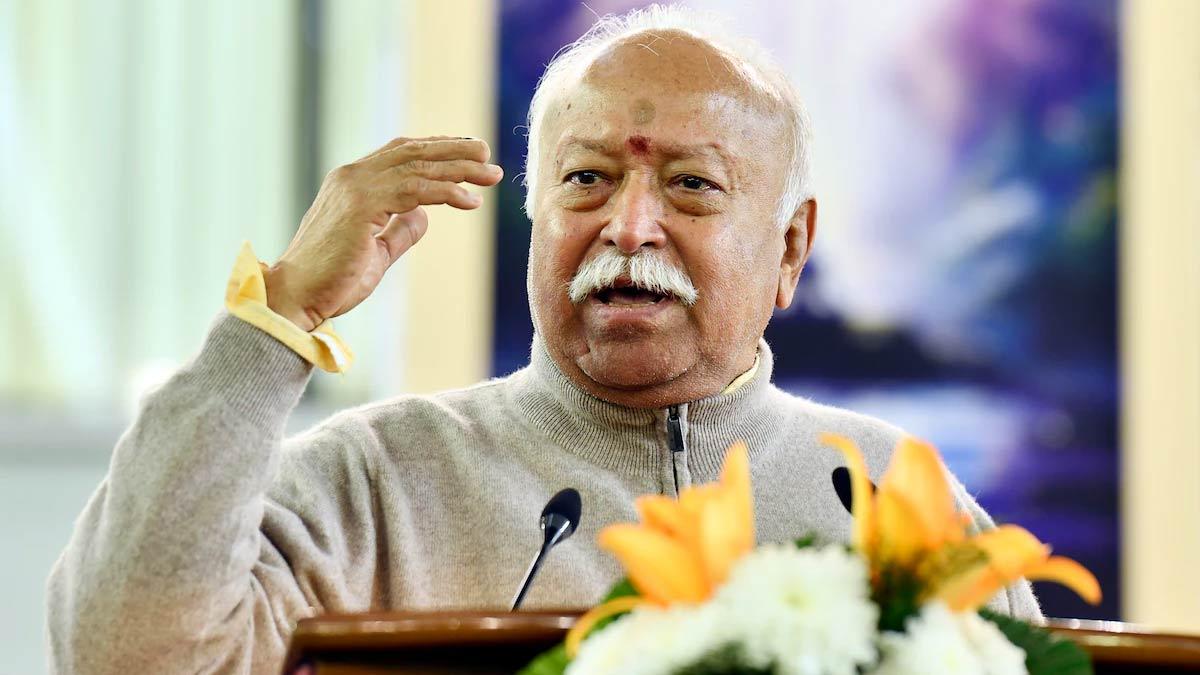


RSS chief Mohan Bhagwat on Tuesday asserted that the organisation does not wield control, either "directly or remotely", over its volunteers (swayamsevaks) or the affiliated outfits, reiterating that the Sangh does not seek to form pressure groups but unite people.
Bhagwat was giving the keynote address on the first day of his three-day lecture series at Vigyan Bhawan, '100 Years Journey of RSS: New Horizons'.
He clarified that RSS volunteers are autonomous within different organizations and do not have to adhere to the Sangh's instructions.
The statement comes against the backdrop of perceptions of differences between the BJP and the Sangh on organisational matters in the ruling party, which is ideologically inspired by the Hindutva organization. Bhagwat, however, did not name any party in this context.
He stated, "Swayamsevaks are making efforts in all fields to infuse the needful change and constructive development based on the concepts and 'sanskar' they have acquired through the Sangh. But whatever these swayamsevaks do, it's their work which is independent, separate and autonomous. Its credit belongs to them, not the Sangh. The Sangh, nonetheless, has to bear the discredit (if any). 'Kyonki maal hamara gaya hai' (Because it is our swayamsevaks who are doing this)."
"The Sangh is not controlled, neither remotely nor directly," he added, affirming, "We do not wish to construct any pressure group; Sangh is for organizing all people everywhere in India."
Referring to the Bharatiya Mazdoor Sangh (BMS) as an example, Bhagwat stated, "Our swayamsevaks went there to work. They have provided a new vision to the whole world with regard to the labour sector."
He explained that not all the people in an organisation are a swayamsevak. "There are many other people. There are such organisations which are not of the Sangh. They are of the people. There are some organisations which have been formed by the swayamsevaks or they have gone there. There are fluctuations in their power. They have maintained the organisation, carrying everybody with them. This is what we have learned," he said.
Bhagwat also added that the relationship between the Sangh and its swayamsevaks is long-standing. "Because of this, the swayamsevaks greet us, speak. We speak as well. They pose questions, we explain. If something strikes our mind, we explain. They seek assistance, we assist. We do good work everywhere, not just that of swayamsevaks but of anybody as well. There are lots of such instances," he added.
He stressed that there is no compulsion for them to adhere to the Sangh's leadership. "They will listen to what we say and do as they wish. Because they are working in a specific area in which they have experience and expertise," he added.
"It's not that we do not have (the expertise). But eventually, they have to do their work. They must have freedom to do their work and they have it," Bhagwat noted.
He added the Sangh does not interfere with anything done by the organisations except to ensure they function well and the swayamsevaks are good at their work. "They are independent, autonomous and they become self-dependent step by step to the extent that they do not stay in a situation to take help (from Sangh). We are concerned only about swayamsevaks. They manage their organisations," he added.
Read also| RSS Chief Mohan Bhagwat Says Hindu Rashtra is Egalitarian, ‘No Hindu vs Others’