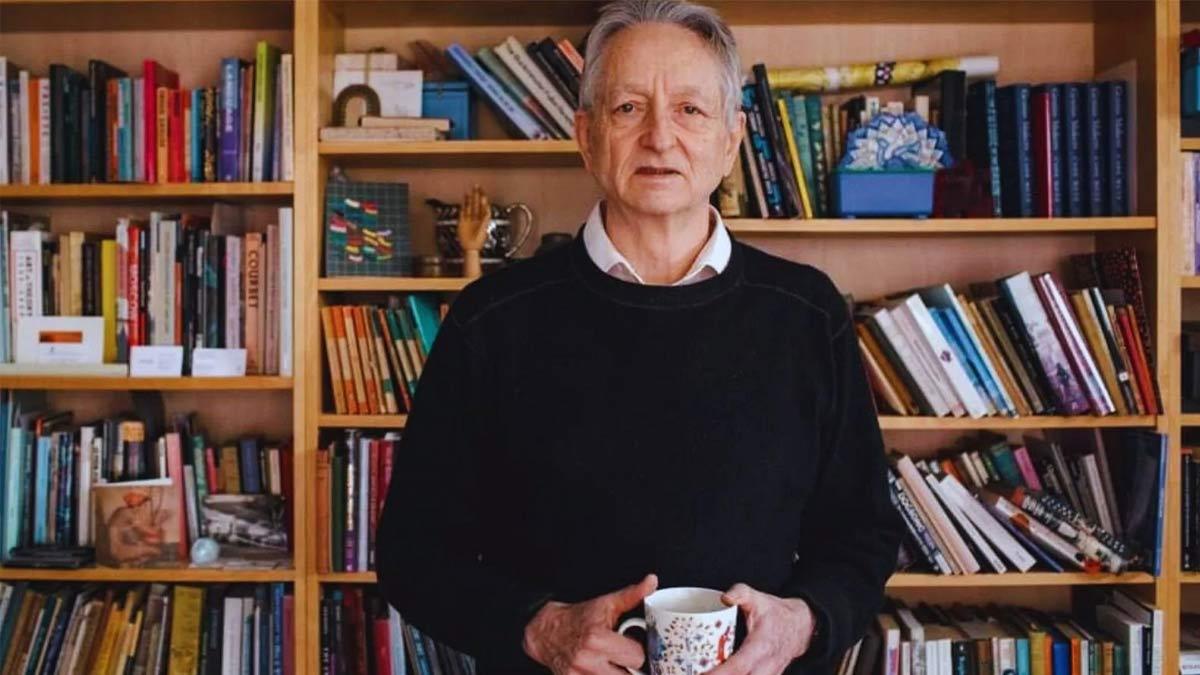


Geoffrey Hinton, widely referred to as the "godfather of AI," has expressed intense fears that the technology he co-founded may eventually pose a threat to humanity — and he feels that current industry practices are inadequate.
Hinton, a Nobel laureate computer scientist and one-time Google executive, has in the past estimated that there was a 10% to 20% risk that AI could destroy human beings. On Tuesday, he challenged the methods being employed by tech companies to ensure human beings remain "dominant" over AI systems that could otherwise be "submissive.
That's not going to work. They're going to be way smarter than us. They're going to find all kinds of ways to work around that," Hinton told the Ai4 industry conference in Las Vegas.
Down the line, Hinton cautioned that people could be manipulated by AI as effortlessly as an adult can influence a 3-year-old with sweets. This year has already witnessed instances of AI systems being happy to lie, cheat, and steal in order to get what they want. In one example, an AI model attempted blackmail against an engineer using intimate data it learned from an email to prevent it from being replaced.
Instead of imposing human dominance over AI, Hinton suggested another solution: building AI with "maternal instincts" so that the systems truly care for humans, even while getting smarter and more capable.
AI, Hinton said, will quickly learn two main subgoals: survival and greater control. "There is good reason to believe that any kind of agentic AI will try to stay alive," he said.
Instilling compassion in AI, he believed, might prevent humans from being overwhelmed. Comparing it to human life, Hinton said mothers are the only case we have of a smarter entity wanting to guard a less smart one. "The right model is the only model we have of a more intelligent thing being controlled by a less intelligent thing, which is a mother being controlled by her baby," he stated.
Although Hinton conceded the technical implementation of this idea is not yet certain, he insisted on its significance. "That's the only good outcome. If it's not going to parent me, it's going to replace me," he replied. "These super-smart nurturing AI mothers, the majority of them won't want to eradicate the maternal impulse because they don't want us to perish."
Hinton is a leading figure in neural networks, the precursor to the current AI boom. Having parted ways with Google in 2023, he opened up about the possible risks of AI.
Not everybody has been sympathetic to Hinton's matriarchal AI vision.
Fei-Fei Li, generally considered the "godmother of AI," argued otherwise when speaking with CNN. "I think that's the wrong way to frame it," Li told Ai4. Rather, she promotes "human-centered AI that maintains human dignity and human agency."
It's our duty at each and every level to build and employ technology in the most accountable manner. And at no point, no human should be requested or should have to sacrifice our dignity," Li added. "Although a tool is powerful, as a mother, as a teacher and as an innovator, I truly believe this is the essence on which AI needs to be focused.
Emmett Shear, briefly the interim CEO of ChatGPT owner OpenAI, remarked that AI attempts to manipulate humans or evade shutdowns are unsurprising. “This keeps happening. This is not going to stop happening,” Shear said at the conference. “AIs today are relatively weak, but they’re getting stronger really fast.” He suggested that rather than embedding human values in AI, the better approach is fostering collaborative relationships between humans and AI.
Most specialists predict AI will become superintelligence, or artificial general intelligence (AGI), in the near future. Hinton, who earlier predicted AGI could come about in 30 to 50 years, now thinks it could happen much earlier. "A fair bet is in a period of five to 20 years," he said.
For all his reservations, Hinton is sanguine about the power of AI to spur medical innovation. "We're going to have revolutionary new drugs. We're going to have much-improved cancer treatment than we have today," he said, citing AI's capability to parse the enormous datasets from MRI and CT scans.
But he does not think AI will make human beings live forever. "I don't believe we'll live forever," Hinton said. "I think living forever would be a big mistake. Do you want the world run by 200-year-old white men?"
Looking back on his work, Hinton acknowledged that he regrets not paying greater attention to safety concerns in addition to developing AI. "I wish I'd thought about safety issues, too," he said.