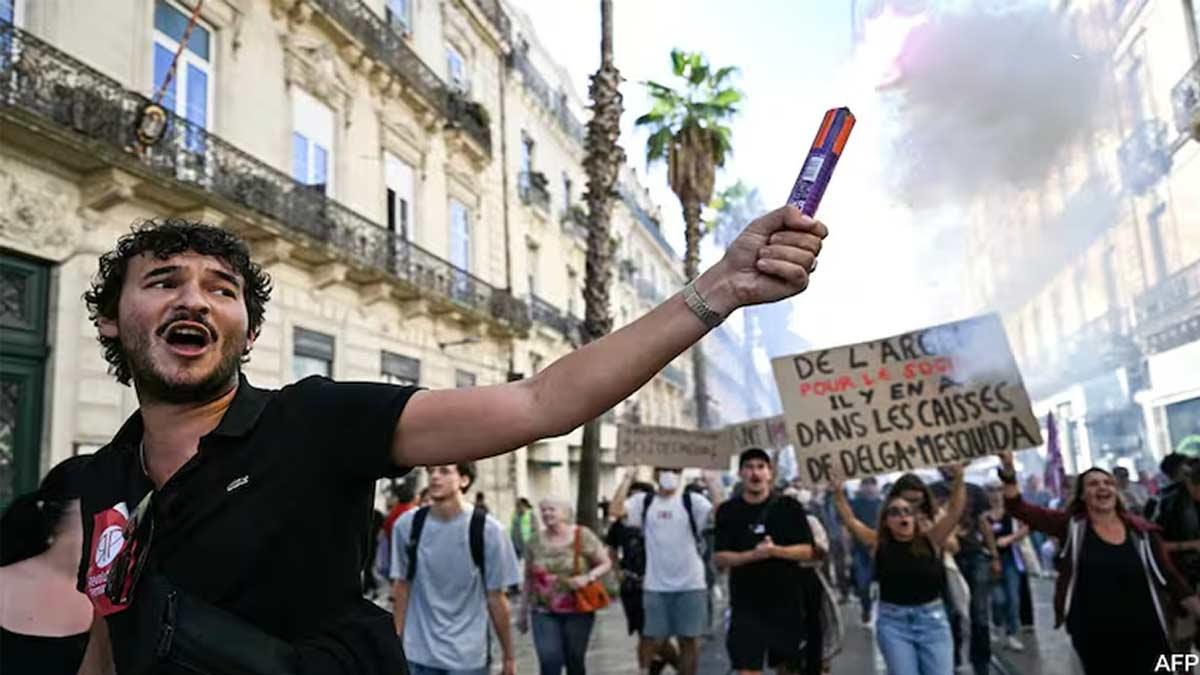


On Wednesday, protests erupted in Paris and elsewhere in France, where they blocked streets, torched cars, and faced tear gas from officers, in an attempt to exert pressure on President Emmanuel Macron and call into question his just-appointed prime minister.
During the initial hours of the protests in the entire country, the interior minister announced close to 200 arrests.
While the movement did not succeed entirely on its declared mission to "Block Everything," the web-born protests, which started last summer, created many disruption hotspots despite an unprecedented deployment of 80,000 officers, who dismantled barricades and made arrests quickly.
Interior Minister Bruno Retailleau announced that a bus had been set on fire in Rennes and that an attack on a power line shut down trains on a southwest route. Protesters were blamed by him for attempting "a climate of insurrection.
However, the initial demonstrations were less intense than previous waves of unrest that had intermittently challenged Macron's leadership. This includes months of nationwide yellow vest protests that shook his first term. Following his reelection in 2022, Macron faced widespread anger over controversial pension reforms and nationwide unrest in 2023 triggered by the fatal police shooting of a teenager on the outskirts of Paris.
In spite of this, bands of protesters repeatedly tried to close Paris' beltway during Wednesday morning's rush hour. They constructed barricades, threw objects at police, brought traffic to a standstill, and engaged in other protest activities, adding to a renewed perception of crisis in France following the recent collapse of government when Prime Minister François Bayrou was defeated in a parliamentary confidence vote on Monday.
Macron named Sébastien Lecornu the new prime minister on Tuesday and immediately faced the tests presented by the protests.
The "Bloquons Tout," or "Block Everything," movement, which grew in popularity during the summer through social media and encrypted messaging applications, organized a coordinated day of blockades, strikes, and demonstrations.
The movement, which went viral without a visible leadership, has a broad range of demands — many of them aimed at the austerity policies promoted by Bayrou prior to his resignation — as well as wider complaints about inequality.
The spontaneous style of "Block Everything" resonates with the yellow vest movement, which started with workers taking over traffic circles to protest at a fuel tax increase while wearing high-visibility vests. It soon engulfed individuals across political, regional, social, and generational divides, brought together by anger at economic disparity and Macron's leadership.
Read also| Nepal PM KP Oli steps down following violent anti-corruption protests: Report
Read also| Rising Khalistani Activities in Canada Ignite Free Speech Debate: Report