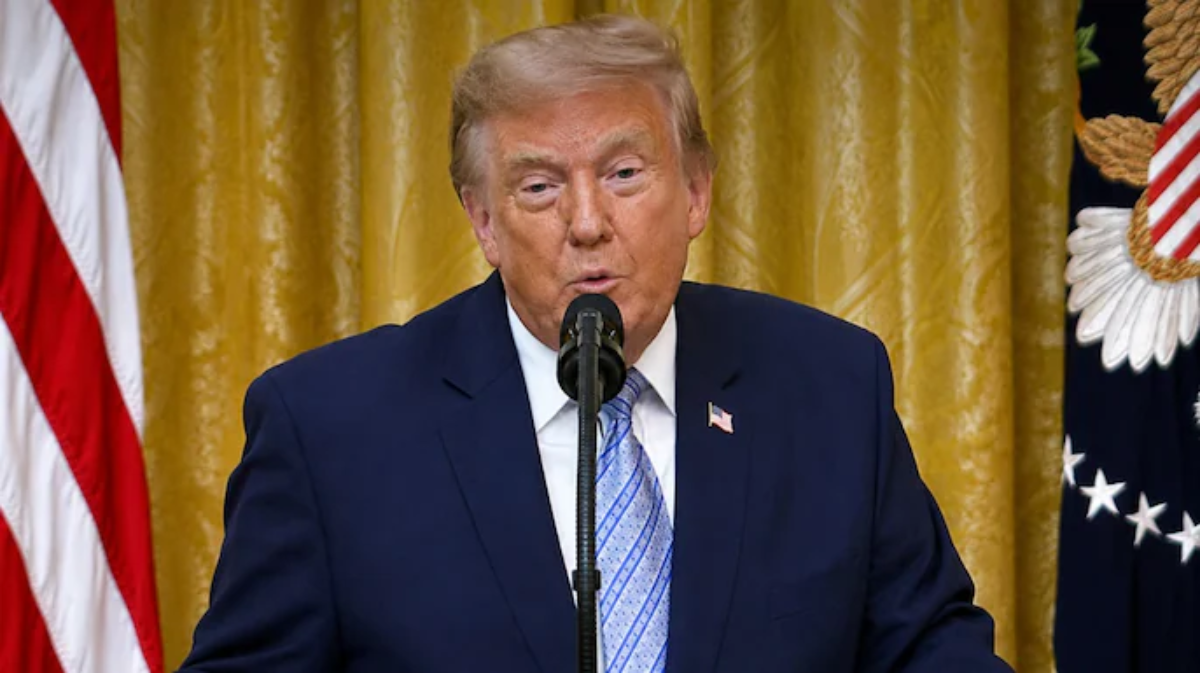



U.S. President Donald Trump told Saturday that the United States is prepared to impose new sanctions on Russia's energy, but insisted that only if all the members of NATO ceased purchasing Russian oil and followed suit would this occur.
Well over three years since Russia's all-out invasion of Ukraine, both the U.S. and the European Union are still importing billions of euros' worth of Russian energy and commodities, such as liquefied natural gas and enriched uranium.
The following is an overview of the most important trade connections between Russia and the EU and U.S., and how they have shifted in the last four years:
The EU has enforced a series of import and export bans, which have reduced exports to Russia by 61% and imports from Russia by 89% from Q1 2022 through to Q2 2025 based on the most recent Eurostat figures.
During Q2 2025, EU export to Russia increased while imports declined, producing a trade surplus of €0.8 billion. However, the EU still imports oil, nickel, natural gas, fertilizers, iron, and steel from Russia.
Four years ago, Russia was the EU's largest petroleum product supplier. But a ban on Russian crude oil exports via sea has reduced its share significantly, from 28.74% in 2021 to 2.01% up to 2025.
Russian petroleum imports decreased from 29% in Q1 2021 to merely 2% in Q2 2025.
Russia's share of EU natural gas imports dropped from 48% in Q1 2021 to 12% in Q2 2025. During the same time, Norway's share increased by 10%, and Algeria became the EU's largest supplier at 27%.
Some EU countries such as Hungary and Bulgaria continue to get Russian gas via the TurkStream underwater pipeline through Turkey.
The EU imports of Russian liquefied natural gas boomed in value from Q1 2021 to Q2 2022 as prices rose. Irrespective of that, Russia's proportion of EU imports of LNG dipped to 14% in Q2 2025 from 22% in Q1 2021.
The United States became Europe's biggest LNG supplier in Q2 2025, representing 54% of imports.
Russia's proportion of non-EU iron and steel imports declined from 18% in 2021 to only 6% in Q2 2025.
As of Q2 2025, Russia was still the EU's leading fertilizer exporter, with its market share increasing from 28% to 34% over a four-year period.
The European Parliament voted for high tariffs on Russian fertilizer imports in May, but they will come into effect progressively, so it is still too early to assess their complete effect.
U.S. imports from Russia declined to $2.5 billion during the first half of 2025, from $14.14 billion four years ago, based on figures from the U.S. Census Bureau and U.S. Bureau of Economic Analysis. The U.S. imported $24.51 billion worth of Russian products since January 2022.
U.S. imports of Russian fertilizers totaled $1.27 billion in 2024, up slightly from $1.14 billion in 2021.
The U.S. imported enriched uranium and plutonium from Russia in 2024 worth $624 million, a drop compared to 2021 when it was worth $646 million.
Exports of Russian palladium to the U.S. fell from $1.59 billion in 2021 to $878 million in 2024.
Read also| 'Won’t stand for intimidation on our streets based on colour of skin': UK PM Starmer
Read also| Lula Declares Brazil’s Democracy and Sovereignty ‘Non-Negotiable’