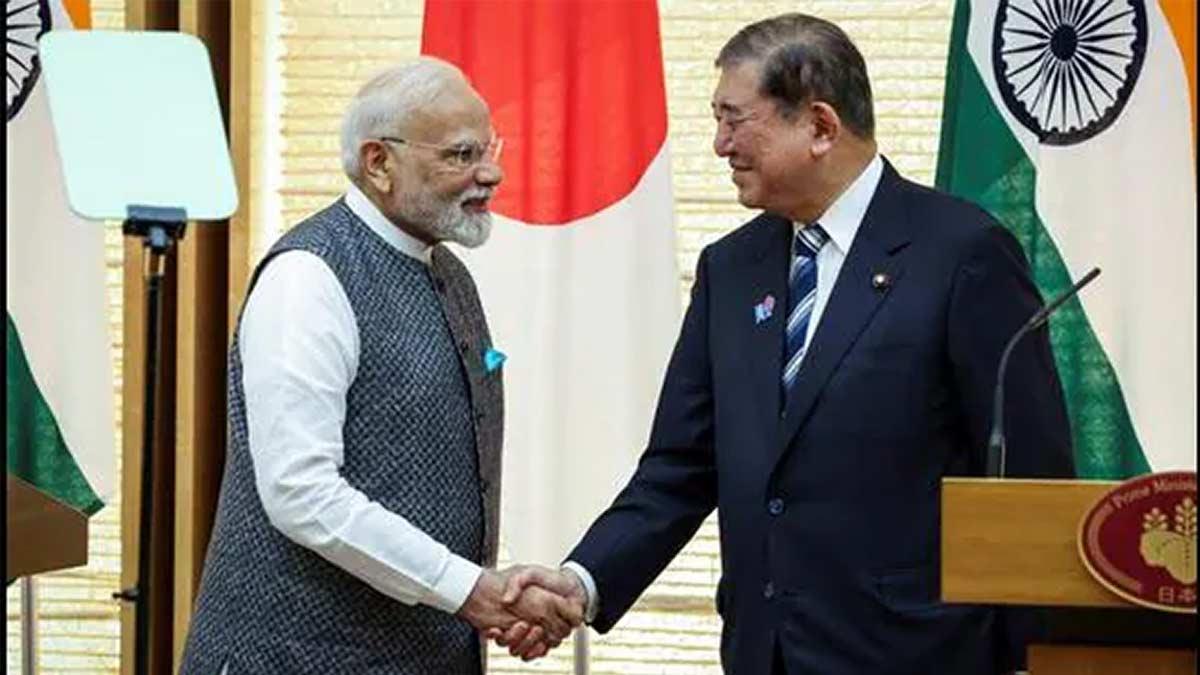


Japan on Friday set an ambitious target of 10 trillion yen ($68 billion) in private investment in India within a decade, as Prime Minister Narendra Modi and his Japanese counterpart Shigeru Ishiba sealed a 10-year vision to strengthen economic ties.
The vision is centered around key areas like technology, digitalization, and rare earths, amidst uncertainties following the US administration's trade policies.
At their biennial bilateral meeting in Tokyo, Modi and Ishiba launched the Economic Security Initiative aimed at enhancing supply chain resilience in critical sectors such as semiconductors, telecommunications, pharmaceuticals, and emerging technologies. They also signed a Joint Declaration on Security Cooperation to direct cooperative action in responding to modern defense challenges.
The summit focused on trade and economic cooperation, coming against the backdrop of international geo-economic instability created by the US' trade and tariff policy under Trump. Even though neither leader directly referenced the US in public comments, they both highlighted the necessity of strengthening the global order and protecting national interests.
“We both agree that as the world’s two largest economies and vibrant democracies, our partnership is extremely important not only for our two countries but also for global peace and stability,” Modi said at a joint media interaction. “Strong democracies are natural partners in shaping a better world.”
He added, “The India-Japan partnership is rooted in mutual trust, reflects our national priorities, and is shaped by our shared values and beliefs. Together, we carry a common dream of peace, progress and prosperity of our peoples and for the world.”
Ishiba said, “We share the responsibility to strengthen [the] international order as we see increasing opaqueness in international circumstances. Japan and India need to bring their strengths together for the peace and stability of the region.”
Both Prime Ministers emphasized Japan's vision for investing 10 trillion yen ($68 billion) in India over the next ten years. Ishiba pointed out that Tokyo would prioritize cooperation in space, future mobility, and the Mumbai-Ahmedabad high-speed rail—a showcase project for both nations. Japan's previous investment target of 5 trillion yen ($34 billion) for 2022-26 was completed two years prematurely.
Ishiba asked India to pursue regulatory and other reforms to allow Japanese businesses to further deepen their supply chains in a joint statement. Modi "reminded him of his desire to undertake further regulatory and other reforms to support investment into India and encouraged more Japanese businesses to make use of these," the statement added.
During a media interaction, Modi averred that the talks have set the stage for a new era of the bilateral special strategic and global partnership initiated in 2014. "We have drawn up a roadmap for the next decade. Investment, innovation, economic security, environment, technology, health, mobility, people-to-people contacts and state-prefecture partnership are at the core of our vision," he elaborated. He included that the new Economic Security Initiative would have a holistic framework for key and strategic sectors, with high technology cooperation being a priority among which are the Digital Partnership 2.0 and AI Cooperation Initiative.
Aside from the bullet train project, some of the other sectors falling under the Next Generation Mobility Partnership are ports, air transport, and shipbuilding. In the realm of space, the Indian Space Research Organisation (ISRO) and Japan Aerospace Exploration Agency (JAXA) agreed to collaborate on the Chandrayaan-5 mission.
Modi reissued his call to Japanese companies to invest in India, echoing his statement a day earlier at an economic forum, that they could employ India to "make for the world." He further mentioned, "We believe Japanese technology and Indian talent are a winning combination."
He also underscored a human resource exchange action plan that will ease the migration of 500,000 individuals in five years, with "50,000 skilled Indians" making an active contribution to the economy of Japan.
Ishiba said that, in consideration of the quality of Indian STEM talent, fewer than 2,000 Indian students are studying in Japan. "We have to bring in more high-skilled talents from India for the development of the Japanese economy and for the vitalisation of local communities," he emphasized, stating that the two sides will agree on an action plan for a "larger flow of mutually complementary talents in both directions.
Ishiba emphasized that Japan and India “should take advantage of each other’s strengths to bring solutions to our challenges,” noting that the Economic Security Initiative would encourage investments and innovation, allowing Japan to grow by accessing India’s vast market. Tokyo’s investments and technology transfers will also support New Delhi’s “Make in India” and “Make for the World” initiatives.
Under the Economic Security Initiative, both PMs instructed their foreign ministries to speed up exchanges at the policy level in order to find concrete results and projects in strategic areas. Both parties will also cooperate on protecting high-tech trade and relaxing each other's export control difficulties.
For the Mumbai-Ahmedabad high-speed rail, both nations concurred to "coordinate for the earliest commencement of operations and collaborate on the introduction of the new Japanese Shinkansen technology in India." India also accepted Japan's proposal to introduce the E10 Shinkansen, running on the Japanese signaling system, in the early 2030s. For this purpose, it was agreed to commence work immediately required for early installation of the signalling, including the Japanese system, as well as for the introduction of the General Inspection Train (GIT) and one set of E5 series Shinkansen rolling stock," the joint statement stated.
Defence and security cooperation were also prominently placed, considering China's continued aggressive actions in the East and South China Seas. Modi and Ishiba vowed to collaborate to maintain a free, open, peaceful, prosperous, and rules-based Indo-Pacific.
"We have shared interests on cyber security and terrorism. Our shared interests are related to defence and maritime security. We have concluded that we would further enhance mutual cooperation in defence industry and innovation," Modi stated.
Ishiba noted that Japan and India share fundamental values and must maintain a free and open Indo-Pacific based on international order and the rule of law. Bilateral security cooperation has deepened significantly over the past two decades, exemplified by the Unicorn project for the Indian Navy. This collaboration will be further strengthened by the Joint Declaration on Security Cooperation, he said.
The two PMs showed "serious concern" regarding the situation in the South China Sea and East China Sea, echoing their "strong opposition to any unilateral actions that threaten the safety as well as freedom of navigation and overflight, and seek to alter the status quo by force or coercion." Speaking of China's actions, the PMs also "shared their serious concern over the militarisation of disputed features.
Read also| In India, capital does not just grow, it multiplies: PM Modi in Tokyo