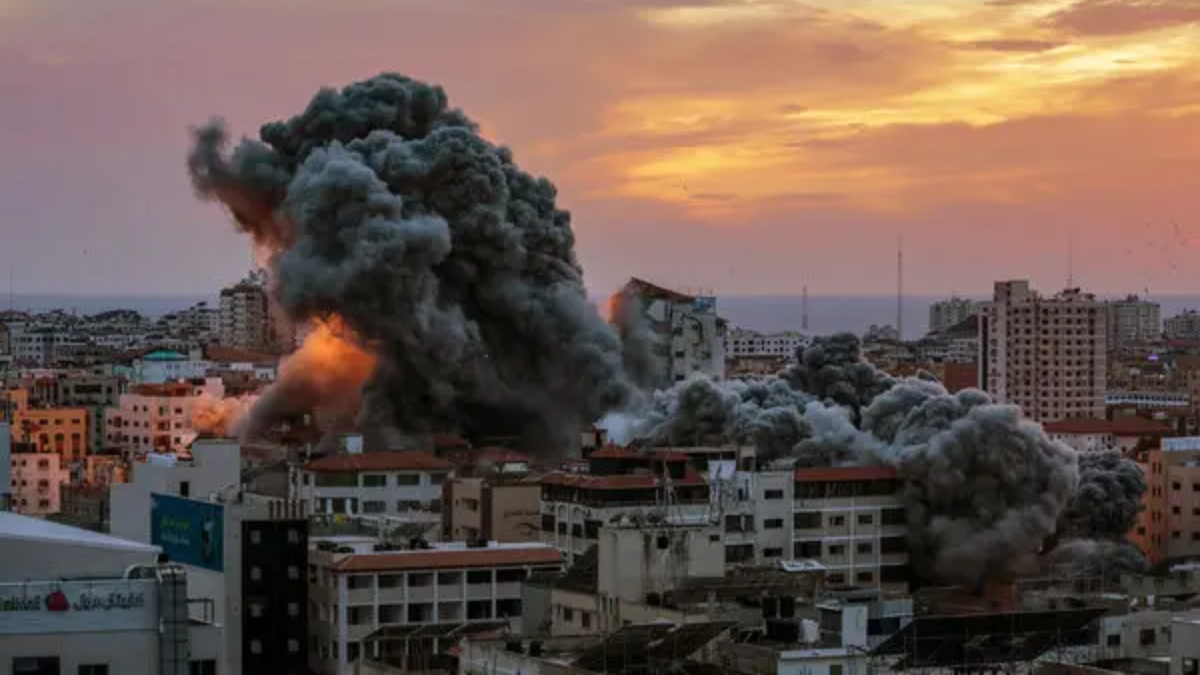


Whole neighborhoods in Gaza are devastated. Hundreds of thousands are trapped in flimsy tents, competing for essentials such as food, water, and electricity.
Within the backdrop of this humanitarian catastrophe, a leaked 38-page paper from Donald Trump's government — the Gaza Reconstitution, Economic Acceleration and Transformation (Great) Trust — maps out plans to "radically change Gaza," integrating it into the India–Middle East–Europe Economic Corridor (Imec).
While framed as a reconstruction effort, the report highlights "massive US gains," the speeding up of Imec, and the building of an "Abrahamic regional architecture," a phrase alluding to the 2020 Abraham Accords that normalized Israel, the UAE, and Bahrain relations under US facilitation.
In most respects, the plan is a reflection of Israeli prime minister Benjamin Netanyahu's "Gaza 2035" vision, the 2024 proposal to make Gaza a sterilized logistics center connected to Saudi Arabia's Neom project, obliterating meaningful Palestinian presence.
As my co-authors and I discuss in our new book Resisting Erasure: Capital, Imperialism and Race in Palestine, this follows a trend of policies denuding Palestinians of political choice, reducing Gaza to a location for investment.
Imec was initially pledged during the 2023 G20 summit in New Delhi by the US, EU, India, Saudi Arabia, and the UAE. It has been portrayed as a revolutionizing infrastructure project that foresees a web of railways, ports, pipelines, and digital cables linking South Asia to Europe through the Arabian Peninsula.
Israel, although not a signatory, has an implicit presence. The corridor runs from Indian ports to the UAE, then by land via Saudi Arabia and Jordan to Israel's Haifa Port, and across the Mediterranean to Greece and Europe.
Although initiatives such as Imec are framed in terms of efficiency — quick trade, reduced costs, new energy and data corridors — their implications are fundamentally political. For the US, Imec acts as a counterbalance to China's Belt and Road Initiative and incorporates India into a US-centric system. Europe views it as insurance against Suez Canal and Russian pipe dependence.
Gulf monarchies seek to establish themselves as the region's trade and transportation center. Israel markets Haifa as a gateway for Euro-Asian trade, and India opens quicker access to Europe and solidifies relationships with both Washington and the Gulf.
Gaza as barrier and gateway
The scheme pictures Gaza as an Iranian outpost menacing Imec and as a traditional crossroads of trade connecting Egypt, Arabia, India, and Europe.
By evoking Gaza's commercial heritage, the paper positions the territory as a natural logistics center poised to "thrive once again" at the hub of a "pro-American regional order." It suggests expanding Gaza's port from Egypt's al-Arish, linking local industries to regional supply chains, and respatializing land into "planned cities" and virtual economies.
What is being imagined is not the rehabilitation of residents but transforming Gaza into a logistics center supporting Imec.
The most striking feature of the Great Trust is its vision of direct trusteeship. It envisions a US-led government arrangement, starting with a bilateral US–Israel agreement and ultimately creating a multilateral trust. This would control Gaza's security, relief distribution, and redevelopment. Even after a "Palestinian polity" comes into being, the trust would retain powers by means of a Compact of Free Association.
Even the most far-reaching US occupation strategies in Iraq and Afghanistan never publicly envisioned converting a land into a corporatized trusteeship for world capital.
'Voluntary' relocation
The strategy also makes provision for "voluntary relocation." Palestinians who depart Gaza would be given relocation packages, rent allowances, and food allowances. The plan presumes that a quarter of the population will leave for good, outlining financial models evidencing increased profitability with each resident departure.
In fact, "voluntary" evacuation under attack and starvation is not voluntary at all. Israel's blockade has resulted in what UN officials have characterized as engineered mass starvation. Portraying out-migration as an option de facto approves ethnic cleansing.
The report also imposes Abraham Accords labels on the future of Gaza. Logistics centers in Rafah, rail corridors, and highways are all assigned "Abrahamic" names, indicating Saudi and Emirati patronage.
The vision has in mind techno-futurist realizations such as intelligent manufacturing clusters, AI-governed data hubs, high-end tourism resort areas, and ID-based digital cities, where accommodation, health, business, and work are all mediated by ID-based digital systems.
One of the central objectives of the Great Trust is to bring in Gulf investment under US stewardship. The scheme envisages $70–100 billion of public investment and $35–65 billion from private investors, financing ports, railways, hospitals, and data centers.
While not technically part of the Abraham Accords, Saudi Arabia expressed support for Imec. For Washington, rebuilding Gaza is a last push to win over Riyadh to formal normalization — a prize holding the "Abrahamic order" together.
The strategy places Saudi Arabia at the center of rebuilding Gaza, providing rich stakes in Imec. To make this palatable, it proposes a restricted Palestinian "polity" in trusteeship.
Though framed as a step toward statehood recognition, any future acknowledgment must be scrutinized: what is actually being recognized, and whose interests does it serve?
At its core, the Great Trust is an investment prospectus. Gaza, currently valued at “practically $0,” is projected to reach $324 billion within a decade. The territory is less a society than a distressed asset to be monetized — disaster capitalism at its most acute.
But fantasies of free-trade zones and cities of the future crash into reality. Palestinians have consistently spurned such plans. The leaked memo, though, exposes how Gaza's future is being constructed within a larger US strategy to remake the region.