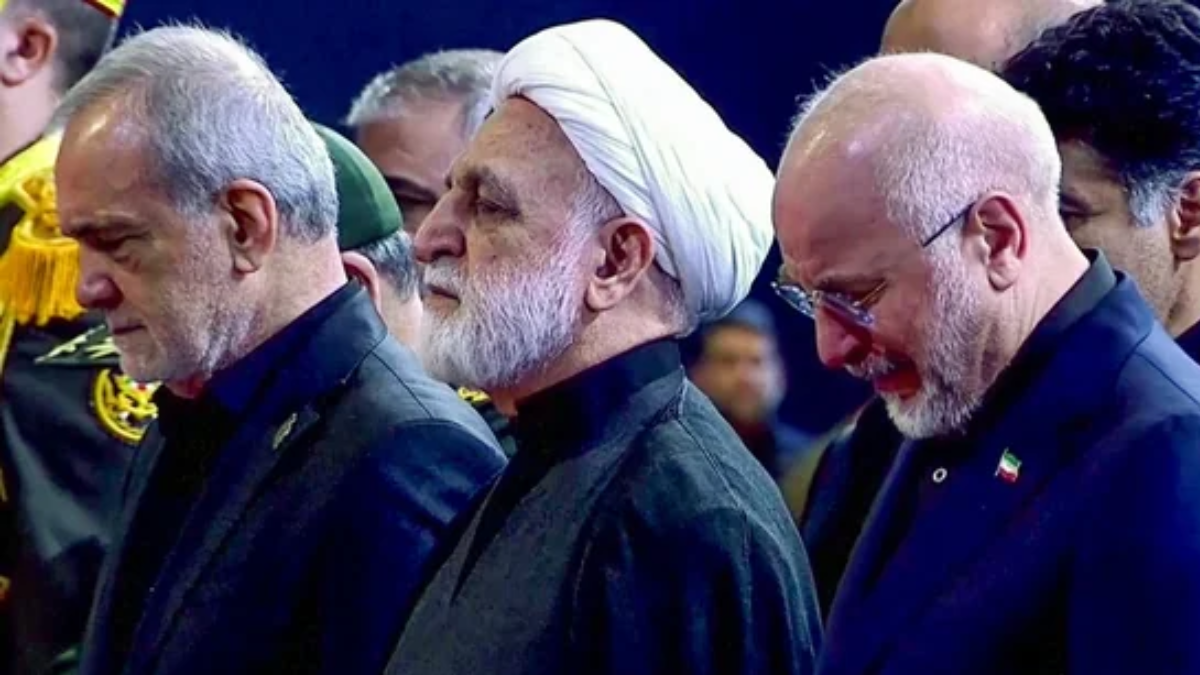


Scenes of grief marked the funeral ceremonies for Iran's late Supreme Leader Ali Khamenei in Tehran on Friday, with senior Iranian leaders, including President Masoud Pezeshkian, Foreign Minister Abbas Araghchi and Parliament Speaker Mohammad Bagher Ghalibaf, seen in tears as the country's top leadership paid its final respects.
State media reported that Khamenei's body was brought to Tehran's Grand Mosalla religious complex on Friday, where funeral proceedings commenced.
Preparations for the ceremony had been underway since Thursday, with workers making arrangements at the Grand Mosalla complex while security forces restricted vehicle movement around the venue as crowds gathered.
Ahead of the funeral, Ghalibaf urged Iranians to participate in large numbers, saying a massive public turnout would serve as a response to Khamenei's death in US-Israeli strikes carried out on the opening day of the conflict.
Iranian authorities expect attendance to range between 15 million and 20 million people, a figure that would make the event the largest state funeral in the country's history.
Public holidays have been declared in Tehran as well as the holy cities of Qom and Mashhad, where the later stages of the funeral and burial ceremonies will be held.
Officials have also ordered all public and private offices in Tehran to remain closed from Saturday through Monday. Traffic restrictions have been imposed across much of the city centre, while Tehran's airspace will be partially closed from Friday and completely shut on Monday.
The funeral process began in Tehran on July 4 and is scheduled to conclude with Khamenei's burial in his hometown of Mashhad on July 9. Additional memorial events are planned in Qom and Iraq during the intervening days.
Ahead of the ceremonies, Iran issued fresh warnings to the United States and Israel against any military action.
"We warn the enemies of Iran, especially the U.S. and the Zionist regime (Israel), to avoid any miscalculation and to think about the harsh retaliation our armed forces would make to any threat and aggression against our country,” Ali Abdollahi, commander of Khatam al-Anbiya Central Headquarters, said in a statement carried by state media.
A similar warning had been issued on Wednesday by Foreign Minister Abbas Araghchi, who said Tehran would respond immediately and forcefully to any threat against the country or its leadership. His remarks followed comments by Israeli Defence Minister Israel Katz, who said Iran's current Supreme Leader Mojtaba Khamenei was "marked for death."
Iran also warned commercial vessels transiting the Strait of Hormuz to strictly adhere to its navigation protocols.
"Any failure to comply, deviation from the designated route, or disregard for the navigation protocols of the Islamic Republic of Iran in the Strait of Hormuz will be met with an immediate and forceful response from the armed forces, endangering the security of the violating vessels," the Iranian statement said.
It further cautioned that any intervention by US forces in the strategic waterway "will be met with a rapid and decisive reaction."
Under an interim arrangement, Iran and the United States agreed to permit ships to pass through the Strait of Hormuz without transit charges for 60 days. Tehran, however, said it would continue to control shipping routes and begin levying passage fees once the temporary agreement expires.
Meanwhile, a report by The New York Times, citing current and former US officials, said Washington had enlisted several West Asian countries to warn Iran about possible Israeli assassination plots targeting senior officials that could have jeopardised ceasefire negotiations launched in early April.
According to the report, US officials were particularly concerned that Israel might attempt to assassinate Foreign Minister Abbas Araghchi and Parliament Speaker Mohammad Bagher Ghalibaf during the fragile negotiations.
To prevent any such action from derailing the talks, the United States reportedly requested countries in the region to alert Tehran that the two Iranian leaders could be potential Israeli targets.
Also Read | China Says India-Japan Ties Should Not Be Directed Against Third Countries