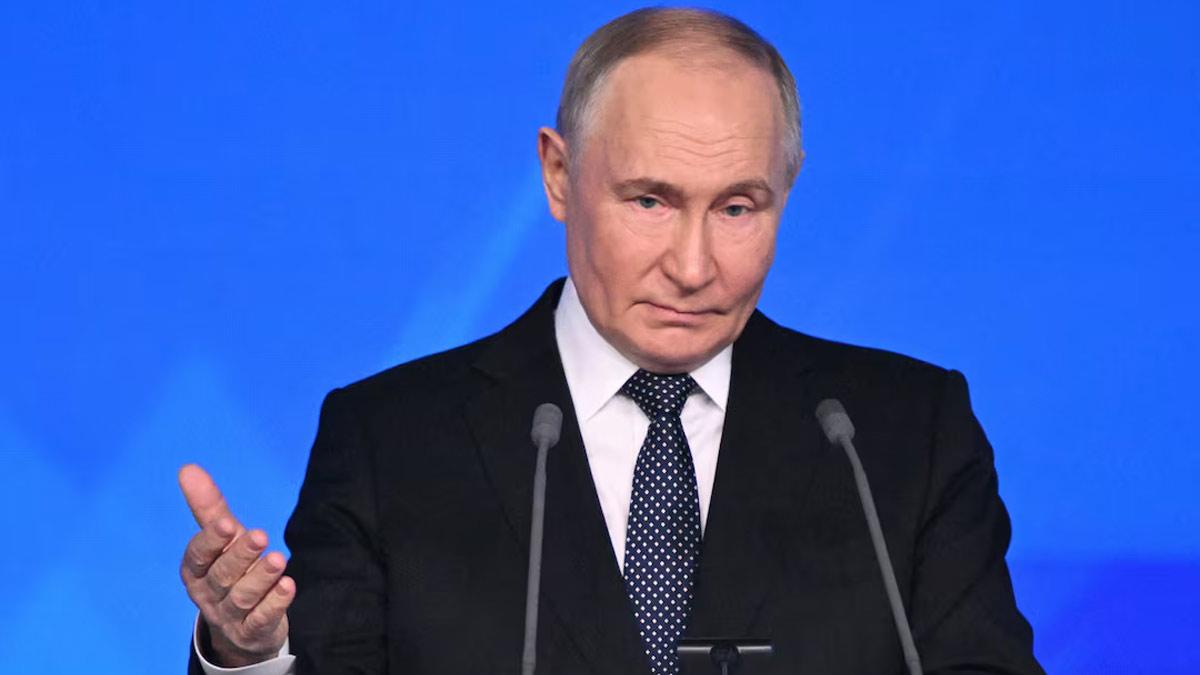


Russian President Vladimir Putin made the announcement on Friday that production of Russia's newest hypersonic missile system, Oreshnik, has started and reaffirmed to deploy it to Belarus before the end of the year.
Addressing Belarusian President Alexander Lukashenko at a session on Valaam Island just outside St. Petersburg, Putin stated that the Russian military has already earmarked deployment sites in Belarus for the intermediate-range ballistic missile system.
"Preparatory work is underway, and probably we will have completed it before the end of the year," Putin stated. He also said that the initial series of Oreshnik missiles and related systems have now been placed in active military service.
Russia has now first tested the Oreshnik missile in action in November targeting a defunct Soviet-era missile factory in the Ukrainian city of Dnipro. The weapon, whose name is derived from the Russian term for "hazelnut tree," has been credited by the Kremlin as having top-class capabilities.
Putin has highlighted the Oreshnik's velocity and firepower, stating its several warheads can fly towards an objective at speeds of up to Mach 10, making them virtually impossible to intercept. He further stated that a conventional attack employing some Oreshnik missiles could be as effective as a nuclear strike.
Warning Western countries, Putin stated that Moscow would think about using the weapon against NATO nations that have allowed Ukraine to use missiles with longer ranges to target locations within Russia.
As reported by Russian military leaders, the Oreshnik can be equipped with both conventional and nuclear warheads and can travel to targets all the way across the European continent. The missile is an example of intermediate-range weapons, which are generally around 500 to 5,500 kilometers in range—a class of weapon that was banned under a Cold War treaty the U.S. and Russia dropped in 2019.
Strategic Alliance with Belarus Deepens
In autumn, Putin and Lukashenko signed a treaty which radically expanded defense cooperation between Moscow and Minsk. The treaty contains security commitments for Belarus, with a possible Russian nuclear umbrella aimed at deterring any foreign attack.
The shift coincided with a restructuring of Russia's nuclear doctrine, which for the first time formally extended Moscow's nuclear shield to Belarus—a move that attracted alarm from Western countries as tensions heightened over the conflict in Ukraine.
President Lukashenko, the Belarusian leader who has held power for more than three decades with Moscow's firm support, permitted Russia to deploy from Belarusian soil to attack Ukraine in 2022 and has let it deploy tactical nuclear weapons in the country.
While the number of weapons deployed is not known, Lukashenko in December said Belarus now hosts several dozen Russian tactical nuclear weapons.
With Belarus sharing a 1,084-kilometer border with Ukraine, the fact that these missiles are now in place reduces tremendously the time Russian forces would take to reach targets within Ukrainian territory. It also increases Moscow's capacity to hit NATO member states within Central and Eastern Europe.
The new nuclear doctrine signed by Putin last year reduces the bar for the use of nuclear weapons. They can be used not only in retaliation against nuclear or other weapons of mass destruction attacks on Russia or its allies, but also against conventional military aggression threatening the sovereignty or territorial integrity of Russia or Belarus.