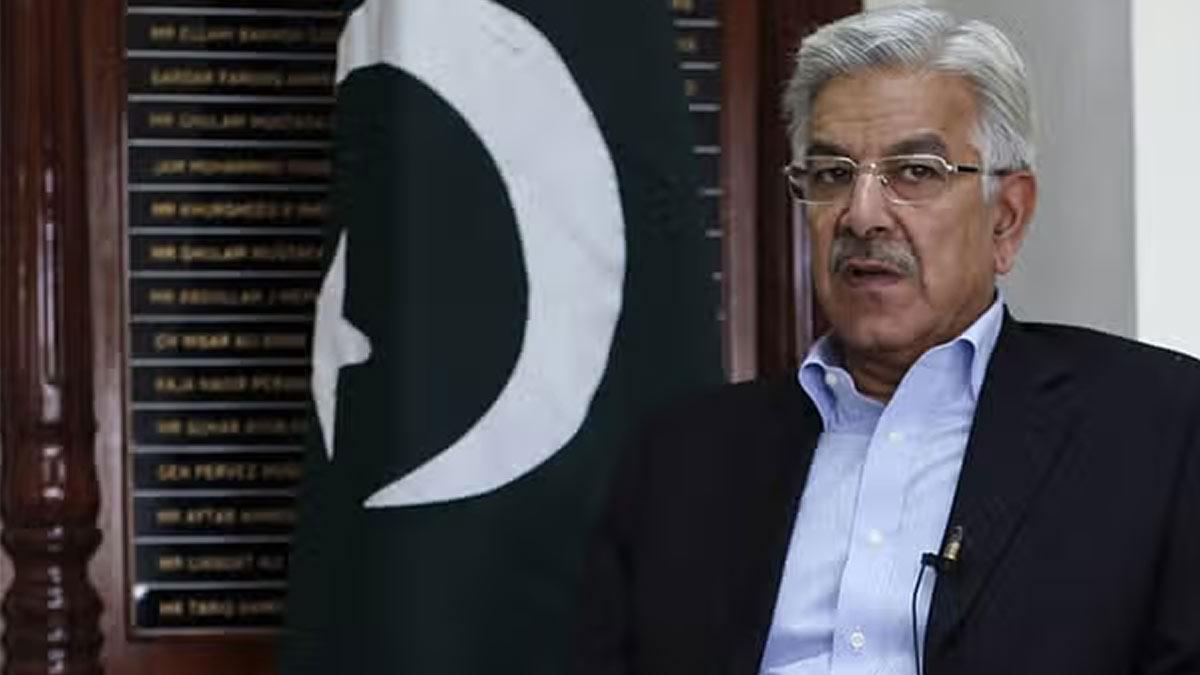


Pakistan Defence Minister Khawaja Asif has backed cricketer Haris Rauf after he performed the contentious '6-0' gesture while playing against India in Sunday's Asia Cup match.
Pace bowler Rauf had an on-field altercation with Indian openers Abhishek Sharma and Shubman Gill, in which he performed the gesture that most thought was a nod to Islamabad's boast of shooting down six Indian fighter planes without loss in Operation Sindoor.
Resharing a post of Ayab Ahmed, on X, a Daily Times columnist in Pakistan, Mr Asif wrote in Urdu, "Haris Rauf is treating them right. Keep it up. Cricket matches keep happening... but 6-0 will not be forgotten by India until the Judgement Day, and the world will remember it too."
Ahmed also posted a second video of Rauf imitating planes being shot down. "Haris Rauf bringing Bharat back to its senses!" he captioned it, adding the Pakistan flag and a smile emoji.
Pakistan's assertions of having brought down six Indian fighter aircraft remain unverified, and the government has issued no proof beyond press releases.
India's Air Force chief, AP Singh, said in August that Pakistan had lost six warplanes. Air Chief Marshal Singh said five fighter planes and one 'large aircraft', presumably a reconnaissance plane, were downed. The latter, destroyed at a distance of 300 km, was the "largest ever recorded surface-to-air kill," he said at an event in Bengaluru.
Although he did not mention the types of fighter jets, he continued that India's airstrikes also hit a surveillance aircraft and "a few United States-made F-16" aircraft parked at two air bases in southeastern Pakistan.
Air Chief Marshal Singh defined that the extent of destruction led Pakistan to realize that further fighting would mean higher losses and that's why they asked for a ceasefire.
"If the truth is in question, let both sides open their aircraft inventories to independent verification - though we suspect this would lay bare the reality India seeks to obscure," he said.
"Such comical narratives, crafted for domestic political expediency, increase the grave risks of strategic miscalculation in a nuclearised environment."
India and Pakistan fought a virtually 100-hour war in early May, the first since the war of 1971. The conflict was the result of Pakistan's response to Indian air strikes on nine terror camps in Pakistan and Pakistan-occupied Kashmir against the Pahalgam terror attack. India has informed that terrorists belonging to The Resistance Front, a faction of the proscribed Lashkar-e-Taiba and backed by Pakistan, were responsible for the attack that took the lives of 26 individuals, a majority of whom were civilians.
Read also| Jaishankar Holds First Post-Tariff Meeting with Rubio on UNGA Sidelines
Read also| Jimmy Kimmel Show Set to Resume After Pause Over Charlie Kirk Remarks